22 thoughts on “Posts are shown latest on top. To make a new post: scroll down the page!”
Matt
Hi everyone,
I’m trying to identify this vintage wooden chess set, possibly French (Lardy, Chavet, or another Jura manufacturer).
Here are its main characteristics:
* King: 80 mm tall, 32–33 mm base diameter, 17 g
* Knight: 50 mm tall, with an unusual asymmetrical mane, deeply carved on one side and almost smooth on the other (identical on all four knights)
* Kings have flat cylindrical finials instead of crosses (both identical, nothing broken)
* Slightly weighted pieces with green felt bases
* Original wooden storage box with two compartments
The pieces appear well-crafted, particularly the knights.
Does anyone recognize the manufacturer, model, or approximate production period?
It would be nice if there is any mark or so on the box?
This is what I think:
It is a “German Knight” Staunton set in size 3/4, most likely produced in the 1970s.
Manufactured in DDR, probably by Uhlig in Borstendorf.
The box is typically German, with sideways sliding lid.
Here’s a picture of the box. It looks fairly crude, but the inscription by my grandfather suggests it’s the original box (I cannot imagine inscribing the date on a replacement box). It’s also perfectly sized for the set, so I don’t think it’s another box at one point appropriated to this set.
It’s definitely painted on the outside as you can see, even at the bottom, covering up any markings that might have been there. If the set, as you suggest, was revarnished it was likely done at the same time the box was painted.
I’m pretty sure the pieces are weighted; I can tip over the pieces pretty far and they’ll return upright, much farther than one would expect with solid wooden pieces.
The felt at the bottom looks too good for me to be an after-market amateur job but in fairness I have no clue how crafty my grandfather was in that respect, the tinkerers were more on my father’s side of the family.
Hello Bart
That box is 100% original, and I do not think it is overpainted.
Pre war boxes of Lardy were stained brown or red (outside only to avoid pieces becoming infected).
You still see the original paper which is very nice to have.
It is a nice piece of chess history and the date is a great asset to have.
I’m pretty sure it is a 1939 7.5cm weighted Lardy with “Tète ordinaire”,
On closer inspection, I think lacquer and felt are original:
You see the amber color of the shellac and the thick wool felt (both pre WWII)
I suspect that the set has been used very little because there is little wear seen.
Hello,
I inherited this set from my grandfather. I don’t know a lot about it; the inside of the simple wooden box has “January 1939” written in it, which I assume is when he bought the set. He used it to play chess every weekend with his brother. The king is about 7.5cm high. He lived in The Hague so it’s safe to assume he got the set there; from what I understand after Euwe’s world championship there was a bit of a chess wave and sets were easy to get. I’ve been told it’s probably French. I’m not sure if that’s something you can tell from this picture, but I’m curious if you’re able to tell anything about it.
Hello Bart
I think it is a Lardy set with a Knight “Tète ordinaire”. But a picture of the box could help; maybe there is a Made in France stamp or so?
But, if it is such a set, then in due time somebody has revarnished the set and added new felts to it, I think.
That is an interesting suggestion, and the confusion is very understandable given how many of these French-style sets ended up on the UK market.
However, there are a few considerations that lead me to believe this is not BCC:
1. The Rooks have 4 crenellations instead of 5.
2. There are no stamps (crowns/stars) on the Knights or Rooks.
3. BCC imported French sets to sell alongside their own products. BCC ended its chessmen activities around 1907, and those early imported sets were most likely made by Ernest Vincent before his collaboration with Pichon. I do not know if the BCC Popular series were imported, but there are some similarities.
4. In my displayed set, the King’s ‘patée’ cross and the 4 crenellations on the rooks are highly typical of the interbellum period in France Jura region, Further I have removed ‘Phidias’ because that trade mark wasn’t present before WWII. Changed picture too.
I am looking for information about chess sets made out of Elastolin, Lineol or similar composite material. Has anyone seen such a set? I have found a wealth of information about toys, especially soldiers, but nothing from the chess community.
Elastolin was a trademark used by the German company O&M Hausser for the toy soldiers and other types of figures that it manufactured from composite material and later from plastic. The Hausser firm was founded in 1904 by Otto and Max Hausser. It closed in 1983.
Lineol, founded by Oskar Wilhelm Wiederholz in Brandenburg in 1906, is a renowned German manufacturer of high-quality, detailed composite figures (mass-produced) and tin toys. In 1961 taken over by Fa. Kurt Haufe.
As far as I know, these companies did not make chess sets.
But I want to know if it is otherwise.
The pattern on the King is deviating from he picture in the pattern book, and is very interesting.
Did you notice that the lower stem of white King is upside down?
Further I believe that a set without the “Bicycle gears” is No.23 (just above No.24 in pattern book).
But maybe your set has another number seen the deviating pattern.
Unfortunately the Queens are not part of this set and are in fact Kings with omitted cross and having no pearls in lower stem (and is a No.24).
Do you have the Rooks flags? I assume they had. You can see it if there are holes on top of the rook.
Dear Schaak Museum Team,
I am writing to share a discovery that might interest your visitors and enrich your page dedicated to the Jaques No. 24 Barleycorn pattern.
While your current exhibit shows a beautiful physical set with elongated foliate barrels, I have recently acquired a 11cm Jaques No. 24 set that provides a fascinating missing link.
My set features Kings with massive “artichoke/tulip” barrels, which are an exact match for the original Jaques pattern book sketch reproduced on your website. Furthermore, detailed macro photography indicated that this specific set is made of ivory, whereas most No. 24 sets are typically found in bone.
I would be honored to share high-resolution photographs of these “Artichoke” Kings and the rest of the set to document this rare high-end sub-variant.
Thank you for your incredible work in preserving chess history.
Best regards,
thank you for the picture from the German National Museum. In the meantime I habe finished my version of the Bauhaus-Chessmen, and I think the measurements/relations are approximately the same. The big cube 30 mm, the small cube 20 mm, and the volume of the Queen’s sphere the same as the volume of the small cube.
The wood is Spindle Tree (Euonymus europaeus) and Beech (Fagus sylvatica), colored black.
Bonjour,
I would like to use some photos (maximum 4) of sets that I think I have identified to illustrate a booklet that traces the history of a French woodturning workshop. But first, please allow me to express my admiration for your magnificent and meticulously documented collection. Along with that of the late Mr. Lanier, your website is one of my favorites to visit.
Sincerely,
Walter H
Hello Walter
I’m glad that you like the website.
And you may use pictures for your booklet and tell me which ones, and I can send better quality ones (i.e. less compressed)
Dear jvreij,
thank you for the picture of the prospectus! Now I have finally decided on the measurement of the Queen’s sphere: In my version it will have the same volume as the volume of the cube on the King (pawn-cube). So the radius of the ball will be the length of the side of the cube divided by 1,612. I think Hartwig may have had the same idea, and the number 1,612 is coincidentially very very close to the “Golden Mean”.
The height of King and Queen will be 5 cm, the diameter of the sphere on the Queen 2,48 cm, therefore 0,48 cm of the sphere will be “hidden” in the base-cube.
I will show you a picture when my version of Hartwig’s chessmen is completed.
Helfried
Hello Helfried
I think you are right.
Last Saturday I was in the German National Museum in Nürnberg and saw an original.
The King are Queen are of exact same height. Of course I couldn’t measure exact sizes.
This is a picture I took:
thank you for your advice!
In Larry List’s “The Imagery Of Chess Revisited”, p. 40, in the chapter Max Ernst, we find the sentence: “The Chess Queen reached the zenith of her fourteen-century rise in the wood chess set Ernst created in the summer of 1944. For the first time in a chess set of any prominence, the figure of the Queen was made decidedly taller than the King.”
There is of course a design problem by putting a sphere on the cube: A sphere which only has the diameter of a pawn looks almost ridiculously lost, and every sphere bigger than that makes the Queen higher than the King.
Hartwig’s solution seems to be a “medium” sphere partly immersed in the cube. In my opinion the workmen who made the Queens had perhaps no exact given measurements of the diameter, or they did not exactly follow Hartwig’s drawings.
Mike Darlow shows pictures of a set which belonged to Gropius himself, where the sphere on the Queen is even not an exact sphere (“Turned Chessmen”, 2004, Fig. 1.67).
Hartwig must have accepted that. What he would have thought of the Replica-Queens with bigger spheres towering above his King we will never know.
For myself I have now decided to use the dimensions in the attached drawing, the sides of the cube being 30 mm long.
Dear Helfried
I think it is a good idea to make the King and Queen equal size. But don’t put the sphere too deep into the cube.
Further you must know that Hartwig designed the King at 5.0 cm. All other dimensions are derived from that (some math gives 2.93 and 2.07 for cubes of King).
Hartwig did not tell the size of the Queen unfortunately, but he says cubes of all pieces are of equal size, except pawn which is size of cube on top of King.
On the internet you can see pictures of original sets to see.
However, you may also see the prospectus in the book of the Bauhaus Archiv (sorry about unsharpness upper-left):
Dear Museum,
I want to make a copy of Josef Hartwirg’s Bauhaus Chessmen in the (final?) version of 1924. Now I am unsure about the measurements of the Queen, because in your set made by Kahe Pasch the Queen is much higher than the King, “exactly according to the original”.
In the pictures of version 16 King and Queen seem to be equal in height, Wichmann (p.326) gives the heights of King and Queen in the set in New York’s Museum of Modern Art with 4,71 centimeters each.
Larry List, The Imagery Of Chess Revisited, Page 57: “The Queen is crowned with a truncated sphere derived from a Pawn-sized cube, making her ever-so-lightly shorter than the King”.
Can you help me understanding these discrepancies? Is there a Hartwig-Version newer than Number 16?
Well, NAEF does produce Queens with very big spheres – but perhaps this is not entirely correct – they would not fit neatly into the original box, I think.
Helfried
Hello Helfried
Thank you very much for bringing it up.
The Bauhaus Archiv booklet about the sets, describes it as the final version.
But all 4 types were considered by Jozef Hartwig as valid.
That booklet shows the prospectus where it looks that the queen has a big sphere.
However, in original sets in carton box of 1924 do the sets have a smaller sphere indeed.
There are several manufacturers now who make affordable replicas with smaller spheres.
Note that the original set was made in different sizes, material and finish. Different boxes too.
So I have to adapt my “exactly according the original”, because it is not possible/defined.
Hi everyone,
I’m trying to identify this vintage wooden chess set, possibly French (Lardy, Chavet, or another Jura manufacturer).
Here are its main characteristics:
* King: 80 mm tall, 32–33 mm base diameter, 17 g
* Knight: 50 mm tall, with an unusual asymmetrical mane, deeply carved on one side and almost smooth on the other (identical on all four knights)
* Kings have flat cylindrical finials instead of crosses (both identical, nothing broken)
* Slightly weighted pieces with green felt bases
* Original wooden storage box with two compartments
The pieces appear well-crafted, particularly the knights.
Does anyone recognize the manufacturer, model, or approximate production period?
Thanks for your help!
Hello Matt
It would be nice if there is any mark or so on the box?
This is what I think:
It is a “German Knight” Staunton set in size 3/4, most likely produced in the 1970s.
Manufactured in DDR, probably by Uhlig in Borstendorf.
The box is typically German, with sideways sliding lid.
Thank you for the reply, and for your insights.
Here’s a picture of the box. It looks fairly crude, but the inscription by my grandfather suggests it’s the original box (I cannot imagine inscribing the date on a replacement box). It’s also perfectly sized for the set, so I don’t think it’s another box at one point appropriated to this set.
It’s definitely painted on the outside as you can see, even at the bottom, covering up any markings that might have been there. If the set, as you suggest, was revarnished it was likely done at the same time the box was painted.
I’m pretty sure the pieces are weighted; I can tip over the pieces pretty far and they’ll return upright, much farther than one would expect with solid wooden pieces.
The felt at the bottom looks too good for me to be an after-market amateur job but in fairness I have no clue how crafty my grandfather was in that respect, the tinkerers were more on my father’s side of the family.
Hello Bart
That box is 100% original, and I do not think it is overpainted.
Pre war boxes of Lardy were stained brown or red (outside only to avoid pieces becoming infected).
You still see the original paper which is very nice to have.
It is a nice piece of chess history and the date is a great asset to have.
I’m pretty sure it is a 1939 7.5cm weighted Lardy with “Tète ordinaire”,
On closer inspection, I think lacquer and felt are original:
You see the amber color of the shellac and the thick wool felt (both pre WWII)
I suspect that the set has been used very little because there is little wear seen.
Hello,
I inherited this set from my grandfather. I don’t know a lot about it; the inside of the simple wooden box has “January 1939” written in it, which I assume is when he bought the set. He used it to play chess every weekend with his brother. The king is about 7.5cm high. He lived in The Hague so it’s safe to assume he got the set there; from what I understand after Euwe’s world championship there was a bit of a chess wave and sets were easy to get. I’ve been told it’s probably French. I’m not sure if that’s something you can tell from this picture, but I’m curious if you’re able to tell anything about it.
Hello Bart
I think it is a Lardy set with a Knight “Tète ordinaire”. But a picture of the box could help; maybe there is a Made in France stamp or so?
But, if it is such a set, then in due time somebody has revarnished the set and added new felts to it, I think.
Here https://www.schaak-museum.nl/000-2/033-2/ is a Lardy set of the 1970s.
It looks very similar, but the Knights have much less detail.
Another detail I like to know is whether the set has been weighted?
Hi,
Please be aware the screenshot set is British Chess Company ‘Staunton Popular’. Kind regards.
Hello Mark
That is an interesting suggestion, and the confusion is very understandable given how many of these French-style sets ended up on the UK market.
However, there are a few considerations that lead me to believe this is not BCC:
1. The Rooks have 4 crenellations instead of 5.
2. There are no stamps (crowns/stars) on the Knights or Rooks.
3. BCC imported French sets to sell alongside their own products. BCC ended its chessmen activities around 1907, and those early imported sets were most likely made by Ernest Vincent before his collaboration with Pichon. I do not know if the BCC Popular series were imported, but there are some similarities.
4. In my displayed set, the King’s ‘patée’ cross and the 4 crenellations on the rooks are highly typical of the interbellum period in France Jura region, Further I have removed ‘Phidias’ because that trade mark wasn’t present before WWII. Changed picture too.
I am looking for information about chess sets made out of Elastolin, Lineol or similar composite material. Has anyone seen such a set? I have found a wealth of information about toys, especially soldiers, but nothing from the chess community.
Elastolin was a trademark used by the German company O&M Hausser for the toy soldiers and other types of figures that it manufactured from composite material and later from plastic. The Hausser firm was founded in 1904 by Otto and Max Hausser. It closed in 1983.
Lineol, founded by Oskar Wilhelm Wiederholz in Brandenburg in 1906, is a renowned German manufacturer of high-quality, detailed composite figures (mass-produced) and tin toys. In 1961 taken over by Fa. Kurt Haufe.
As far as I know, these companies did not make chess sets.
But I want to know if it is otherwise.
Here is an other pictures
The pattern on the King is deviating from he picture in the pattern book, and is very interesting.
Did you notice that the lower stem of white King is upside down?
Further I believe that a set without the “Bicycle gears” is No.23 (just above No.24 in pattern book).
But maybe your set has another number seen the deviating pattern.
Unfortunately the Queens are not part of this set and are in fact Kings with omitted cross and having no pearls in lower stem (and is a No.24).
Do you have the Rooks flags? I assume they had. You can see it if there are holes on top of the rook.
Dear Schaak Museum Team,
I am writing to share a discovery that might interest your visitors and enrich your page dedicated to the Jaques No. 24 Barleycorn pattern.
While your current exhibit shows a beautiful physical set with elongated foliate barrels, I have recently acquired a 11cm Jaques No. 24 set that provides a fascinating missing link.
My set features Kings with massive “artichoke/tulip” barrels, which are an exact match for the original Jaques pattern book sketch reproduced on your website. Furthermore, detailed macro photography indicated that this specific set is made of ivory, whereas most No. 24 sets are typically found in bone.
I would be honored to share high-resolution photographs of these “Artichoke” Kings and the rest of the set to document this rare high-end sub-variant.
Thank you for your incredible work in preserving chess history.
Best regards,
Dear jvreij,
thank you for the picture from the German National Museum. In the meantime I habe finished my version of the Bauhaus-Chessmen, and I think the measurements/relations are approximately the same. The big cube 30 mm, the small cube 20 mm, and the volume of the Queen’s sphere the same as the volume of the small cube.
The wood is Spindle Tree (Euonymus europaeus) and Beech (Fagus sylvatica), colored black.
Bonjour,
I would like to use some photos (maximum 4) of sets that I think I have identified to illustrate a booklet that traces the history of a French woodturning workshop. But first, please allow me to express my admiration for your magnificent and meticulously documented collection. Along with that of the late Mr. Lanier, your website is one of my favorites to visit.
Sincerely,
Walter H
Hello Walter
I’m glad that you like the website.
And you may use pictures for your booklet and tell me which ones, and I can send better quality ones (i.e. less compressed)
Dear jvreij,
thank you for the picture of the prospectus! Now I have finally decided on the measurement of the Queen’s sphere: In my version it will have the same volume as the volume of the cube on the King (pawn-cube). So the radius of the ball will be the length of the side of the cube divided by 1,612. I think Hartwig may have had the same idea, and the number 1,612 is coincidentially very very close to the “Golden Mean”.
The height of King and Queen will be 5 cm, the diameter of the sphere on the Queen 2,48 cm, therefore 0,48 cm of the sphere will be “hidden” in the base-cube.
I will show you a picture when my version of Hartwig’s chessmen is completed.
Helfried
Hello Helfried
I think you are right.
Last Saturday I was in the German National Museum in Nürnberg and saw an original.
The King are Queen are of exact same height. Of course I couldn’t measure exact sizes.
This is a picture I took:
Dear Museum,
thank you for your advice!
In Larry List’s “The Imagery Of Chess Revisited”, p. 40, in the chapter Max Ernst, we find the sentence: “The Chess Queen reached the zenith of her fourteen-century rise in the wood chess set Ernst created in the summer of 1944. For the first time in a chess set of any prominence, the figure of the Queen was made decidedly taller than the King.”
There is of course a design problem by putting a sphere on the cube: A sphere which only has the diameter of a pawn looks almost ridiculously lost, and every sphere bigger than that makes the Queen higher than the King.
Hartwig’s solution seems to be a “medium” sphere partly immersed in the cube. In my opinion the workmen who made the Queens had perhaps no exact given measurements of the diameter, or they did not exactly follow Hartwig’s drawings.
Mike Darlow shows pictures of a set which belonged to Gropius himself, where the sphere on the Queen is even not an exact sphere (“Turned Chessmen”, 2004, Fig. 1.67).
Hartwig must have accepted that. What he would have thought of the Replica-Queens with bigger spheres towering above his King we will never know.
For myself I have now decided to use the dimensions in the attached drawing, the sides of the cube being 30 mm long.
Dear Helfried
I think it is a good idea to make the King and Queen equal size. But don’t put the sphere too deep into the cube.
Further you must know that Hartwig designed the King at 5.0 cm. All other dimensions are derived from that (some math gives 2.93 and 2.07 for cubes of King).
Hartwig did not tell the size of the Queen unfortunately, but he says cubes of all pieces are of equal size, except pawn which is size of cube on top of King.
On the internet you can see pictures of original sets to see.
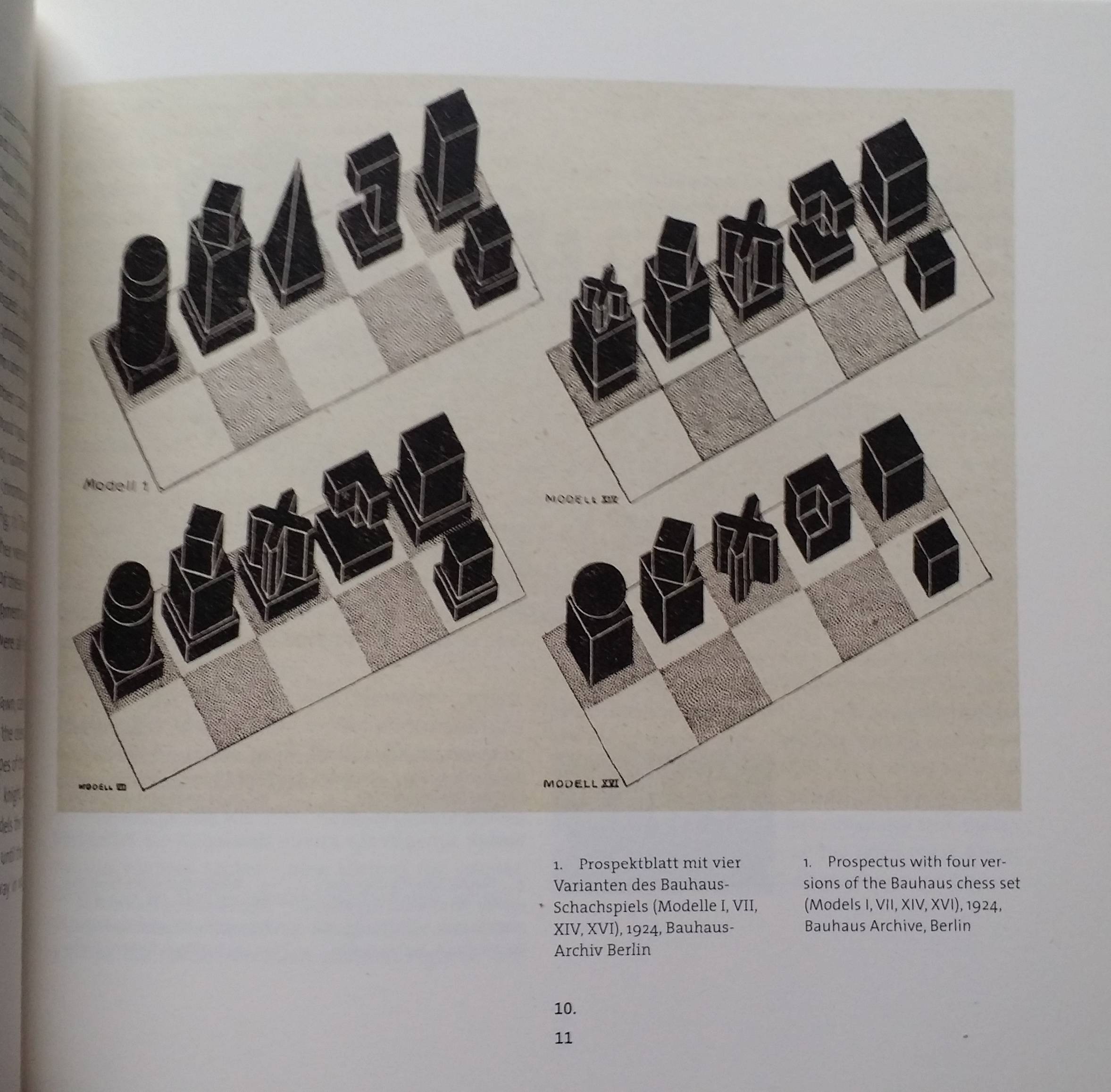
However, you may also see the prospectus in the book of the Bauhaus Archiv (sorry about unsharpness upper-left):
Dear Museum,
I want to make a copy of Josef Hartwirg’s Bauhaus Chessmen in the (final?) version of 1924. Now I am unsure about the measurements of the Queen, because in your set made by Kahe Pasch the Queen is much higher than the King, “exactly according to the original”.
In the pictures of version 16 King and Queen seem to be equal in height, Wichmann (p.326) gives the heights of King and Queen in the set in New York’s Museum of Modern Art with 4,71 centimeters each.
Larry List, The Imagery Of Chess Revisited, Page 57: “The Queen is crowned with a truncated sphere derived from a Pawn-sized cube, making her ever-so-lightly shorter than the King”.
Can you help me understanding these discrepancies? Is there a Hartwig-Version newer than Number 16?
Well, NAEF does produce Queens with very big spheres – but perhaps this is not entirely correct – they would not fit neatly into the original box, I think.
Helfried
Hello Helfried
Thank you very much for bringing it up.
The Bauhaus Archiv booklet about the sets, describes it as the final version.
But all 4 types were considered by Jozef Hartwig as valid.
That booklet shows the prospectus where it looks that the queen has a big sphere.
However, in original sets in carton box of 1924 do the sets have a smaller sphere indeed.
There are several manufacturers now who make affordable replicas with smaller spheres.
Note that the original set was made in different sizes, material and finish. Different boxes too.
So I have to adapt my “exactly according the original”, because it is not possible/defined.