
Beautiful plastic
© 2026 Joost van Reij. All rights reserved.
- Introduction
- Gutta-Percha (1843)
- Xylonite (1867)
- Celluloid (1870)
- Galalith (1895)
- Bakelite (1907)
- Carbolite (1914)
- Urea (1920s)
- Catalin (1926)
- Acrylic (1928)
- Tenite and Polystyrene (1930s)
- Fenolit (1936)
Introduction
Plastics are not of interest to many chess set collectors, but I believe this is unjustified. Early plastic was not used as a cheap substitute for mass production, but celebrated as a premium, highly aesthetic modern material. The chess sets deserve admiration, not dismissal.
The intersection of early plastics and chess history began as a quest for affordable, durable alternatives to luxury materials like ivory, bone, horn, and high-quality hardwood. Around 1850–1900, these traditional materials became increasingly scarce and expensive due to geopolitical shifts and changing trade routes. The transition started with natural Gutta-percha (1843), followed by synthetic Parkesine (1856), Xylonite (1867), and others. Bakelite (1907) is so famous that many other early plastics are frequently mistaken for it.
Same plastic may have different names. English is my standard, but non-English names are sometimes used as well.
This article provides a fairly comprehensive overview of notable early plastics, alongside examples of chess sets crafted from them. Modern plastics, however, have been intentionally excluded; the immense variety in modern materials, designs, and manufacturers makes including them virtually impossible. Perhaps that is a topic for a follow-up article?
Note section format: plastic description, bulleted list of set descriptions, photos.
Gutta-Percha (1843)
Before synthetic plastics, the molding revolution started with this natural thermoplastic. Derived from tree sap in Southeast Asia, the rubbery gutta-percha was initially used for centuries by indigenous communities for everyday tools. Its Western journey began in 1656 when the English botanist John Tradescant the Younger brought samples to London. However, it wasn’t until 1843 that Scottish physician William Montgomerie recognized its industrial potential. This led to the founding of The Gutta Percha Company in London in 1845. Using steam-powered machinery, they pressed the heated material into intricate metal molds.
- A heavy, sharply detailed set with an acanthus motif in the stem, typically dyed in contrasting brick red and deep black, was made by an unknown manufacturer. Because these early natural polymers degrade over time when exposed to air and light, surviving sets are an exceptionally rare find for collectors.
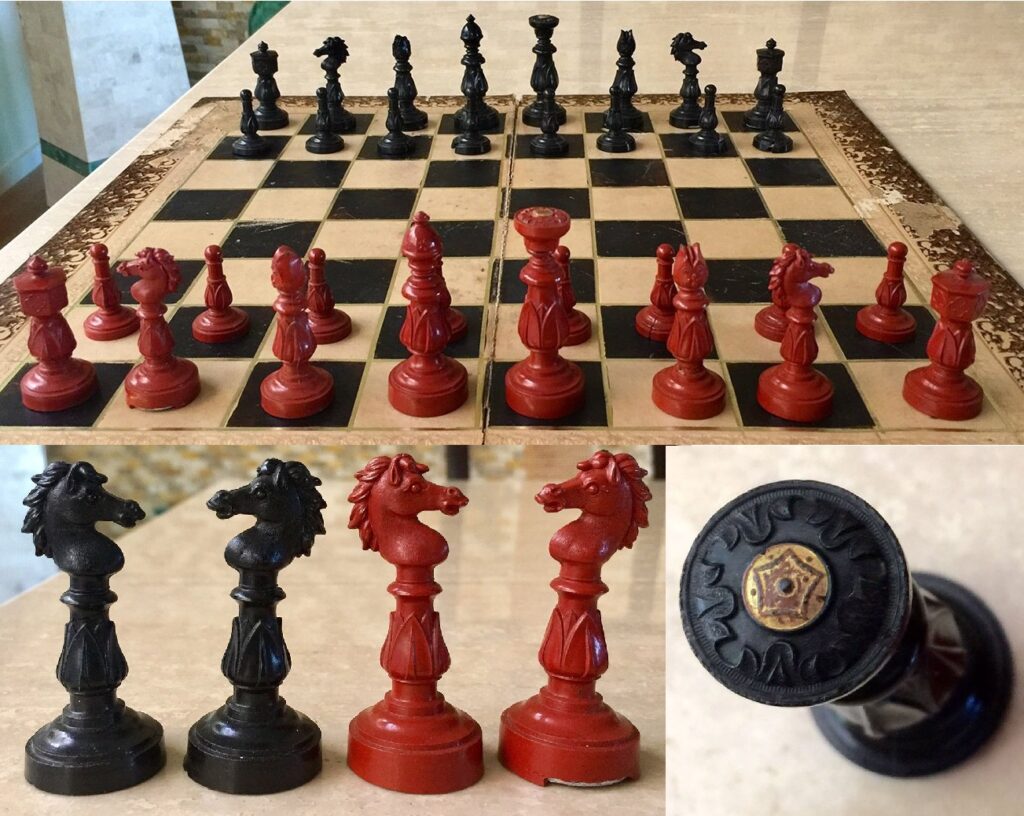
Victorian gutta-percha set (K 2¾” 70mm) ca.1850 (images for educational review courtesy of chessantiques.com)
Xylonite (1867)
The predecessor, Parkesine, was invented by the English chemist Alexander Parkes in 1856 and is considered the first man-made plastic. It was presented to the public in 1862. Parkesine was made from treated cellulose (nitrocellulose) mixed with solvents like alcohol and vegetable oils. It was highly flammable and brittle, leading the company to fail.
Xylonite was developed and patented in 1867 by Daniel Spill, a former colleague of Parkes. Spill took over Parkes’ patents in 1869 and used them to start the new Xylonite Company. He improved the formula by using camphor and castor oil as plasticizers, which made it more flexible and easier to mold. Xylonite was made both in rods and blocks. The rods were used for turning and the blocks were heated in boiling water and pressed in molds.
- The British Chess Company (BCC, 1890–1907) produced sets made entirely of Xylonite in the Imperial and the Royal Chessmen versions. The pieces were turned, except for the Knight’s head, which was molded. These sets are extremely rare and because the material is chemically unstable, not many have survived.
- BCC is best known for its wooden Staunton chess sets with Knights’ heads made of Xylonite. These were advertised as Imperial, Popular, and Royal Chessmen. The last update of the designs was in October 1900.
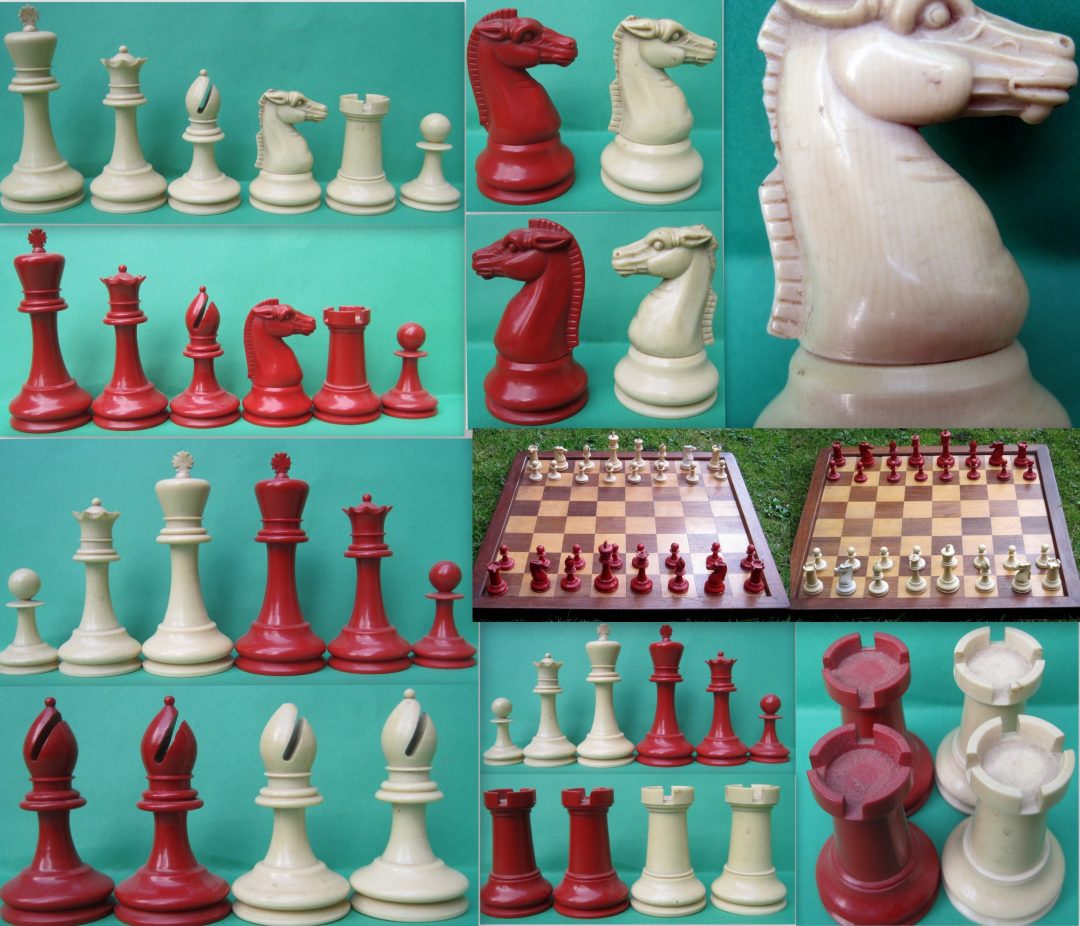
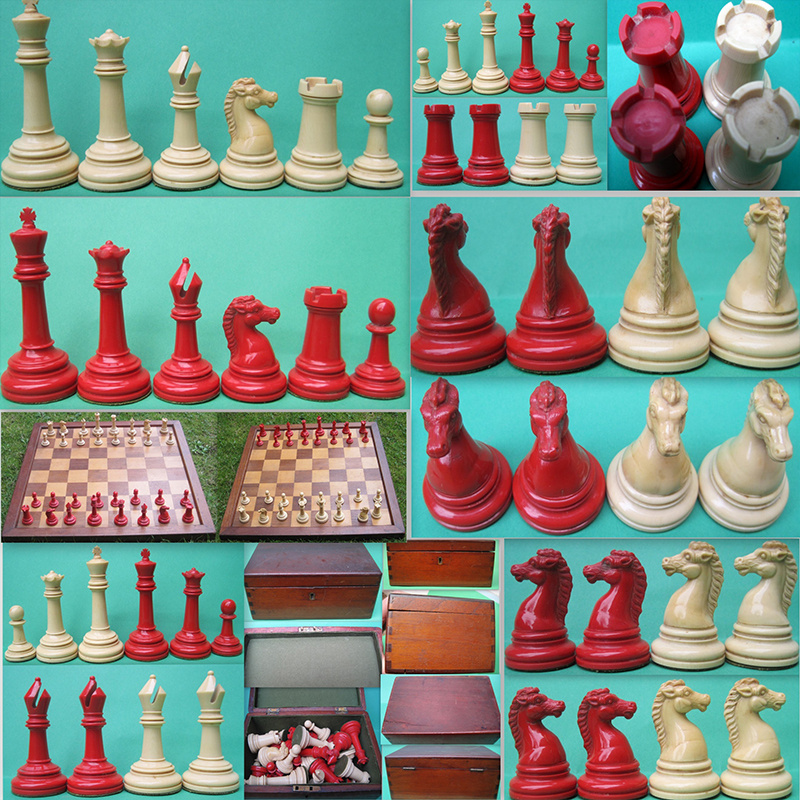
BCC Xylonite (left) Imperial and (right) Royal set ca. 1891 (images from https://guylyonschess.co.uk/)
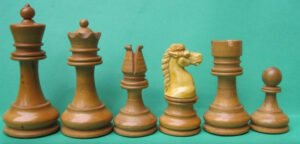
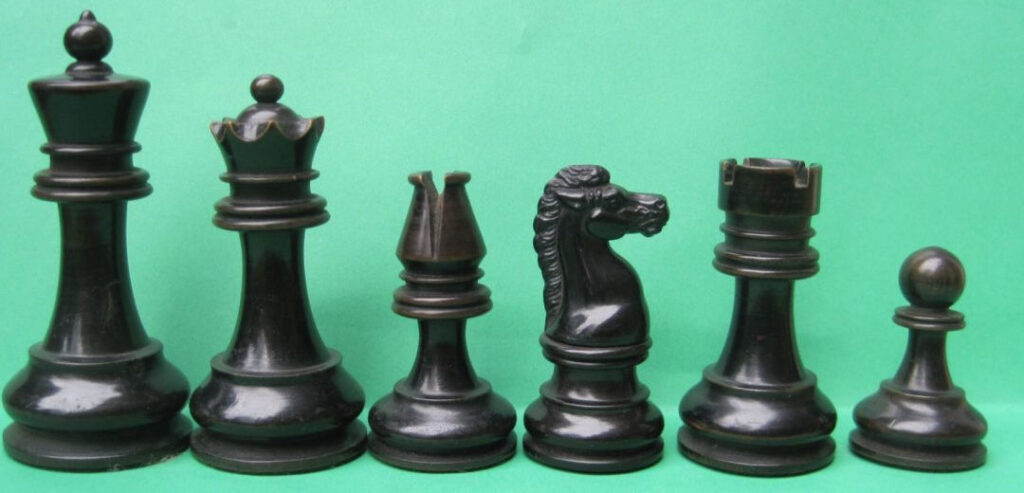
BCC Royal set with Xylonite Knight’s head (K 3¾” 95mm) ca. 1900–1901 (images from https://guylyonschess.co.uk/)
Celluloid (1870)
The American inventor John Wesley Hyatt patented a precursor for coating billiard balls in 1869. True Celluloid featured a perfect balance of camphor and nitrocellulose, creating a stable, moldable thermoplastic. He and his brother Isaiah patented it in 1870 under U.S. Patent #105,338, “Improvement in treating and molding pyroxyline”. Because Parkesine and Xylonite predated Celluloid, Hyatt faced patent disputes with Daniel Spill over the rights to these early plastic formulas. Celluloid, produced from 1872 onwards, became the first commercially successful plastic and was widely used for photographic film and early toys. Notably, ⅒” 2.6mm thick industry-standard sheets were laminated into thicker plates for further processing.
- The use of Celluloid for chess is limited to the flat pieces with symbols in wallet sets. I do not know of full-sized Celluloid chess pieces, though checkers do exist.
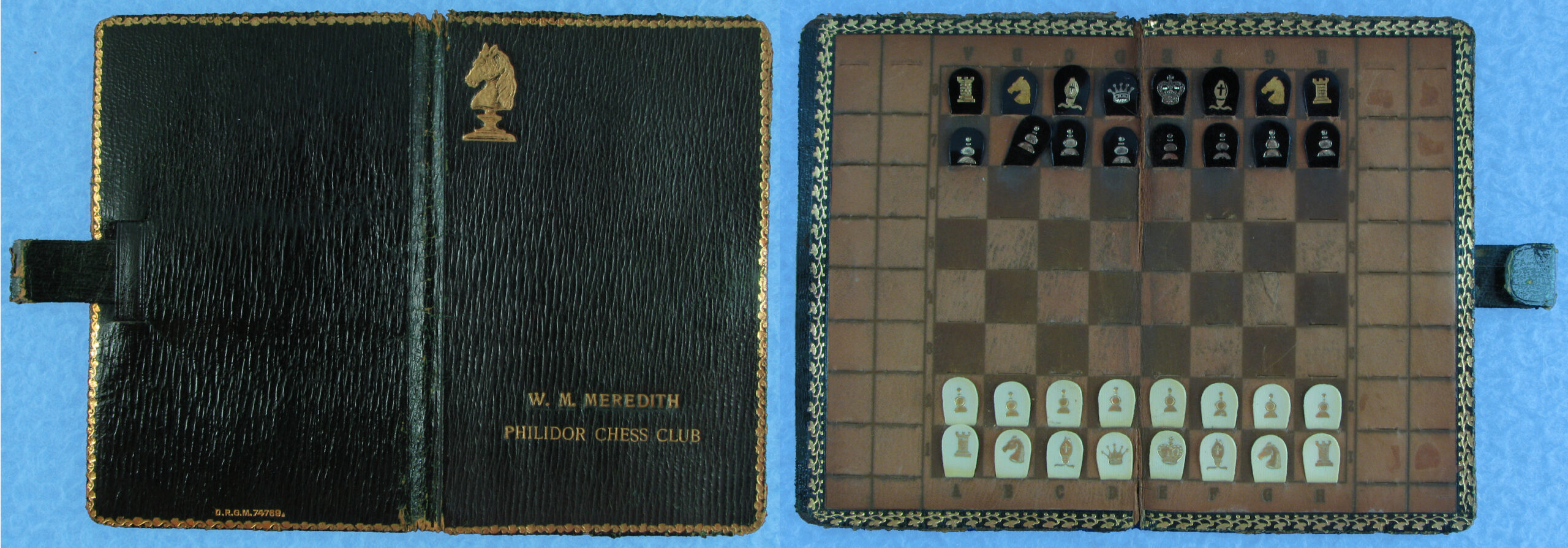
German leather wallet with Celluloid pieces (⅘×⅜” 20×9mm) ca. 1905
Galalith (1895)
Galalith is a hard plastic made from milk casein and formaldehyde, invented by German chemists Wilhelm Krische and Adolph Spitteler in 1895. They developed it during a failed attempt to create an erasable, white, dust-free alternative to slate school blackboards. Galalith made its public debut at the 1900 Paris Exposition as a cost-effective alternative to ivory, and was soon eagerly embraced by the button industry.
In the UK and US, the material was also marketed as Erinoid, a brand name established in 1914. Other notable trade names include Aladdinite, Karolith, Galorn, Kyloid, Inda, and Ameroid (US), Lactoid (UK), Casolith (Netherlands), and Lactoforme (France). Often it is incorrectly referred to as “French Bakelite”.
Galalith requires chemical hardening in formaldehyde, which lasts a few weeks for thin sheets but up to a year for 1″ 25mm thick blocks. Therefore, it cannot be pressed in molds, and chess pieces have to be turned and carved like wood, bone, or ivory. Due to this labor-intensive and highly skilled process, relatively few chess sets were made. WWII shortages halted its use, and the industry never fully recovered. Today, there is renewed interest because Galalith is biodegradable.
- Galalith was used in the early 20th century for Austrian coffeehouse sets, often for compendiums, but also for very rare travel sets.
- French Régence and Staunton sets were for instance made by Henri Chavet and sold in fitted cassettes in the early 20th century. Henri Chavet started his company in 1912 in Dortan. It still exists as Chavet Chess, operating on a down-sized local scale now.
- Large travel sets with squat Staunton pieces were most likely made by Ernest Vincent. Design features match the 1912 Henri Delaire catalogue and a 1933 Ernest Vincent advertisement. The set shown was retailed by Arnau, a very famous historic toy and joke shop in Barcelona at the beginning of the 20th century, which closed ca. 1930.
The conchoidal fracture on the rook reveals that the red pieces are surface-dyed, a technique used prior to full colorization. The checkers were in all likelihood purchased as finished ⅕” 5.2mm thick pieces stamped out of 2-ply celluloid. - An English Staunton set, in a box of which the cover can be unfolded into a board, has a logo reading “RM MURIE”, but that’s an unknown name to me. The pieces were most likely sourced from Uhlig in Borstendorf, Germany.
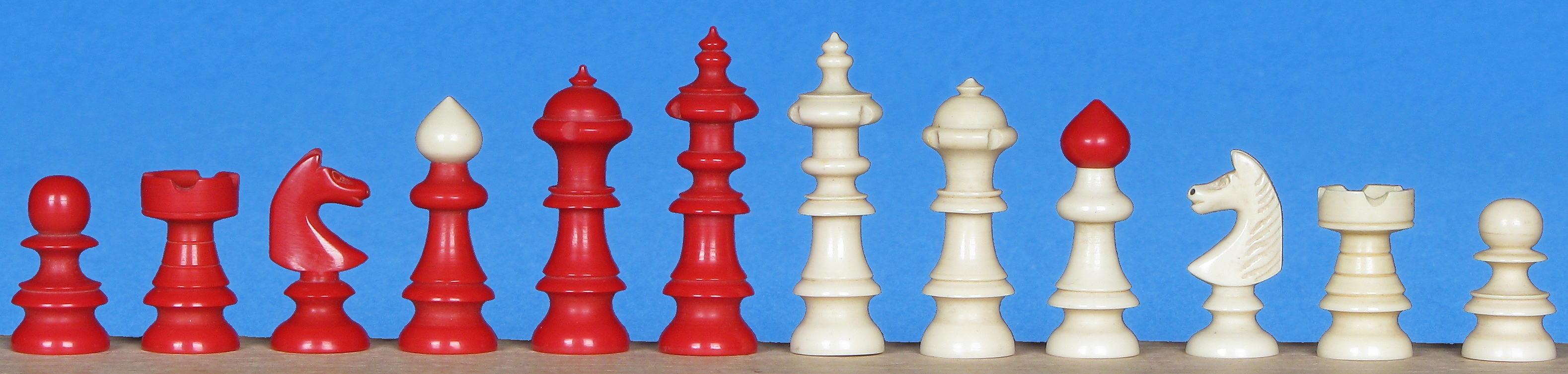
Austrian Galalith Coffeehouse set (K 2³⁄₁₀” 58mm) early 20th century
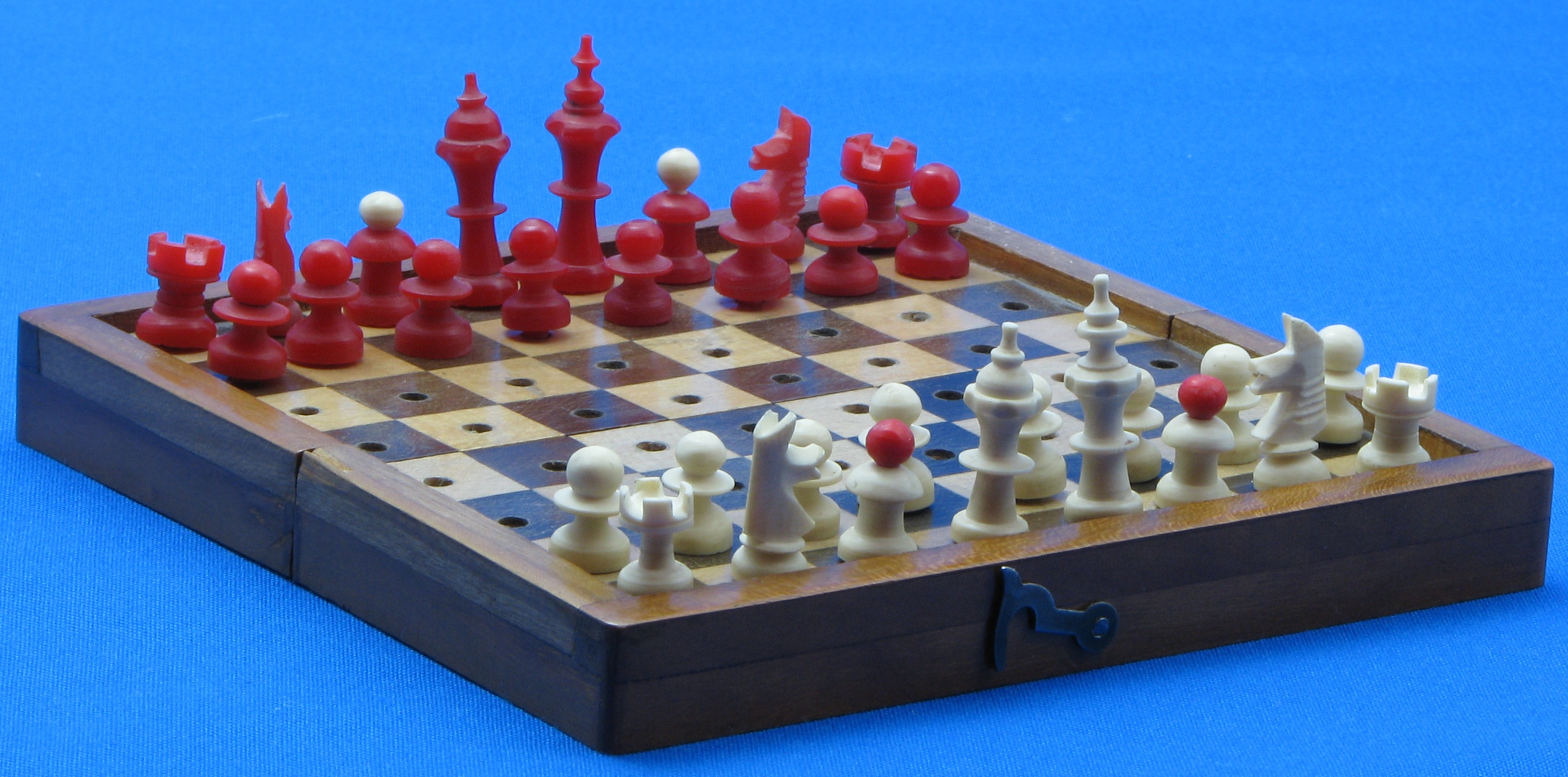
Austrian Galalith Coffeehouse travel set (K 1⅒” 28mm) early 20th century
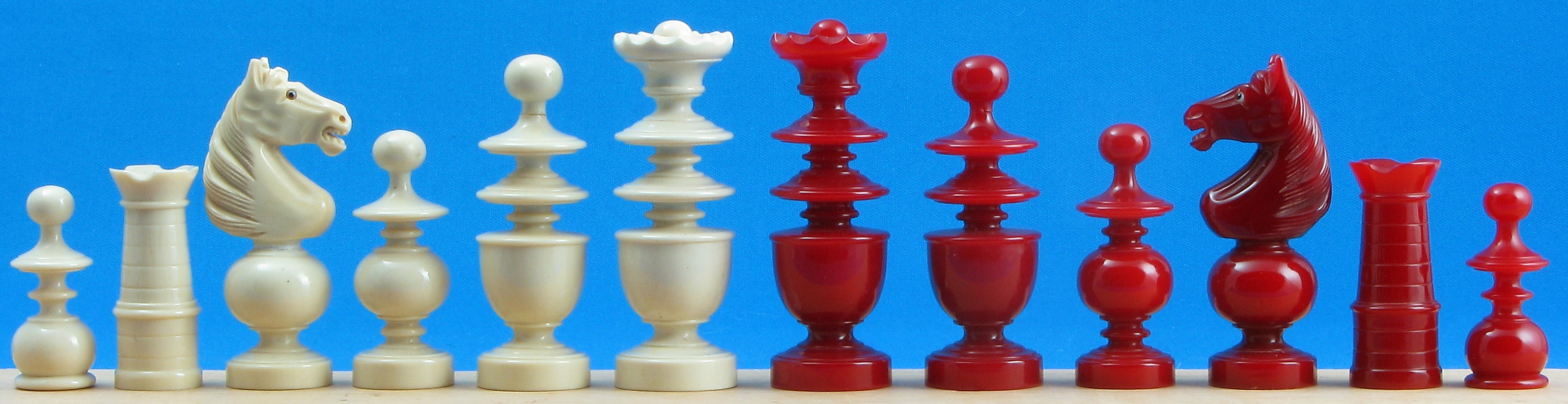
French Galalith Régence set (K 3″ 77mm) most likely by Henri Chavet ca. 1920
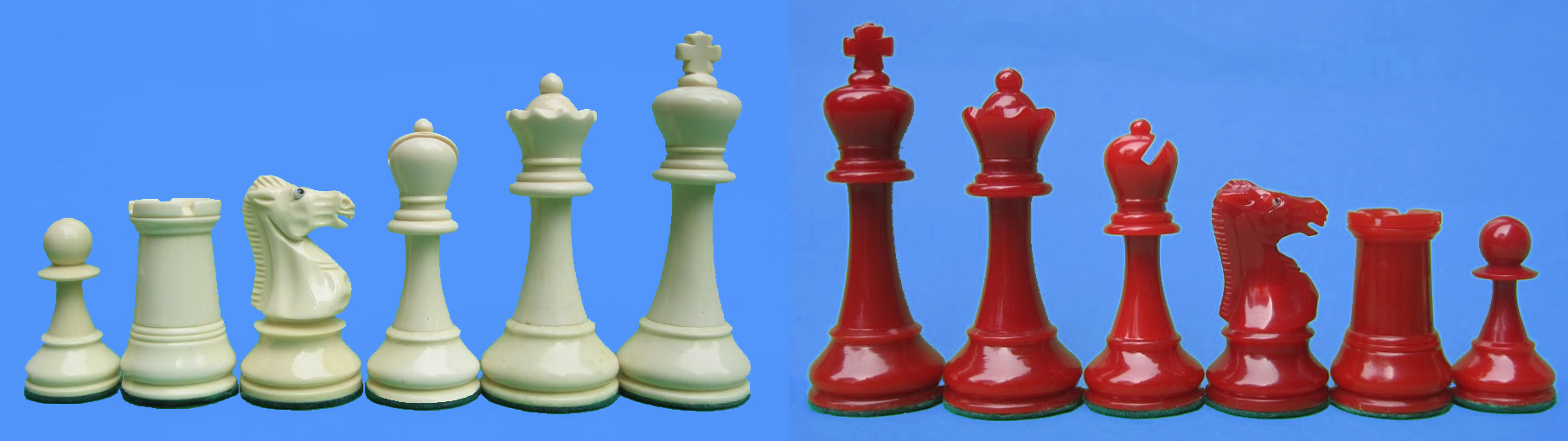
French Galalith Staunton set (K 3″ 77mm) most likely by Henri Chavet ca. 1920
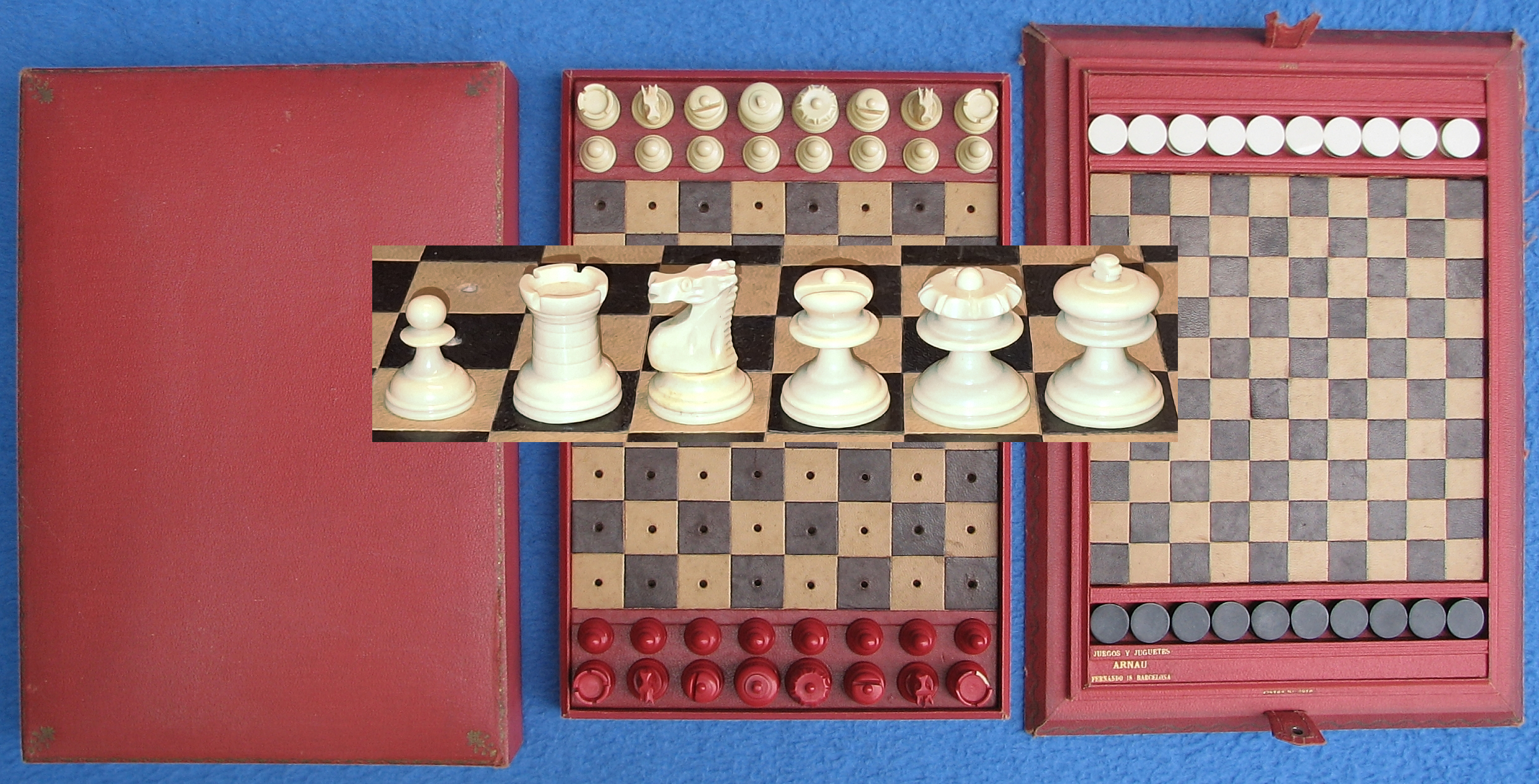
French Galalith large travel set (K 1¼” 32mm) with celluloid checkers most likely by Ernest Vincent early 1920s – gold print: “Juegos y Juguetes Arnau Fernando 18 Barcelona” and “Made in France” (reads upside down)
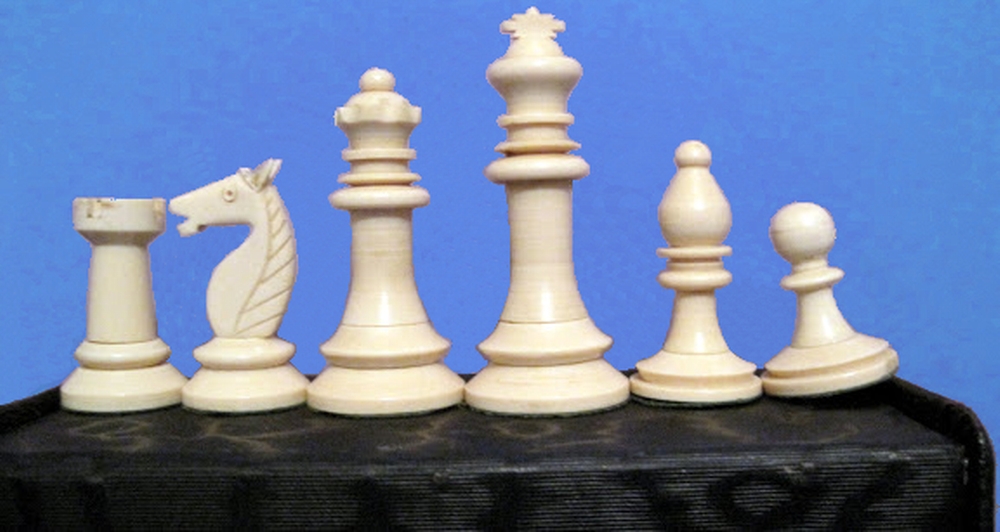
English Galalith Staunton set (K 2¼” 57mm) – logo with “RM MURIE” pieces are most likely made by Uhlig ca. 1925
Bakelite (1907)
Invented by Belgian-American chemist Leo Baekeland, this was the first fully synthetic plastic. It is a thermosetting phenol-formaldehyde resin formed through condensation polymerization, suitable for compression-molding. Because it was heat-resistant and a poor conductor of electricity, it revolutionized early electronics, telephone casings, and automotive parts.
- The “Services” set was distributed by Chad Valley to British Armed Services during World War II. These were compact dual-purpose disk sets featuring chess symbols on one side and flat draughts surfaces on the other. I believe that Lowe in the USA had a similar set. And I know at least 2 other distributors in England.
- Soviet & Eastern European sets were produced widely from the 1930s to the 1980s. These tournament-style sets feature more modest, utilitarian colors like black and mottled dark brown or off-yellow. For example, a notable variation is the Russian “Shkolnik” (Scholar) set of 1952, which was made in a Carbolite version in 1962 and a last iteration, produced in thousands, in the 1970s and 1980s. The Bulgarian “Varna Olympiad” set of 1970 is another example. Sizes do vary a bit (3⅓-3½” 85-90mm).
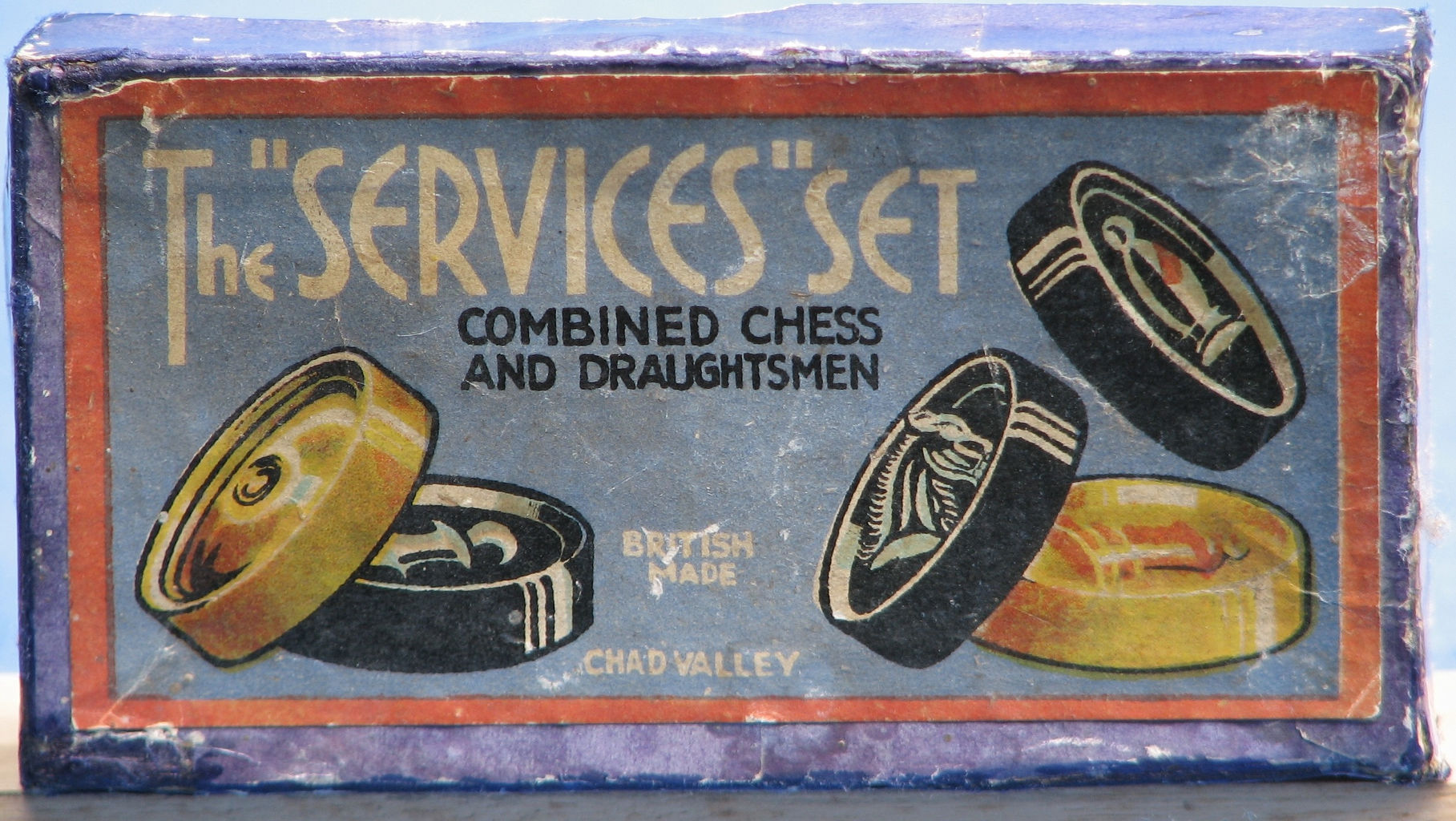
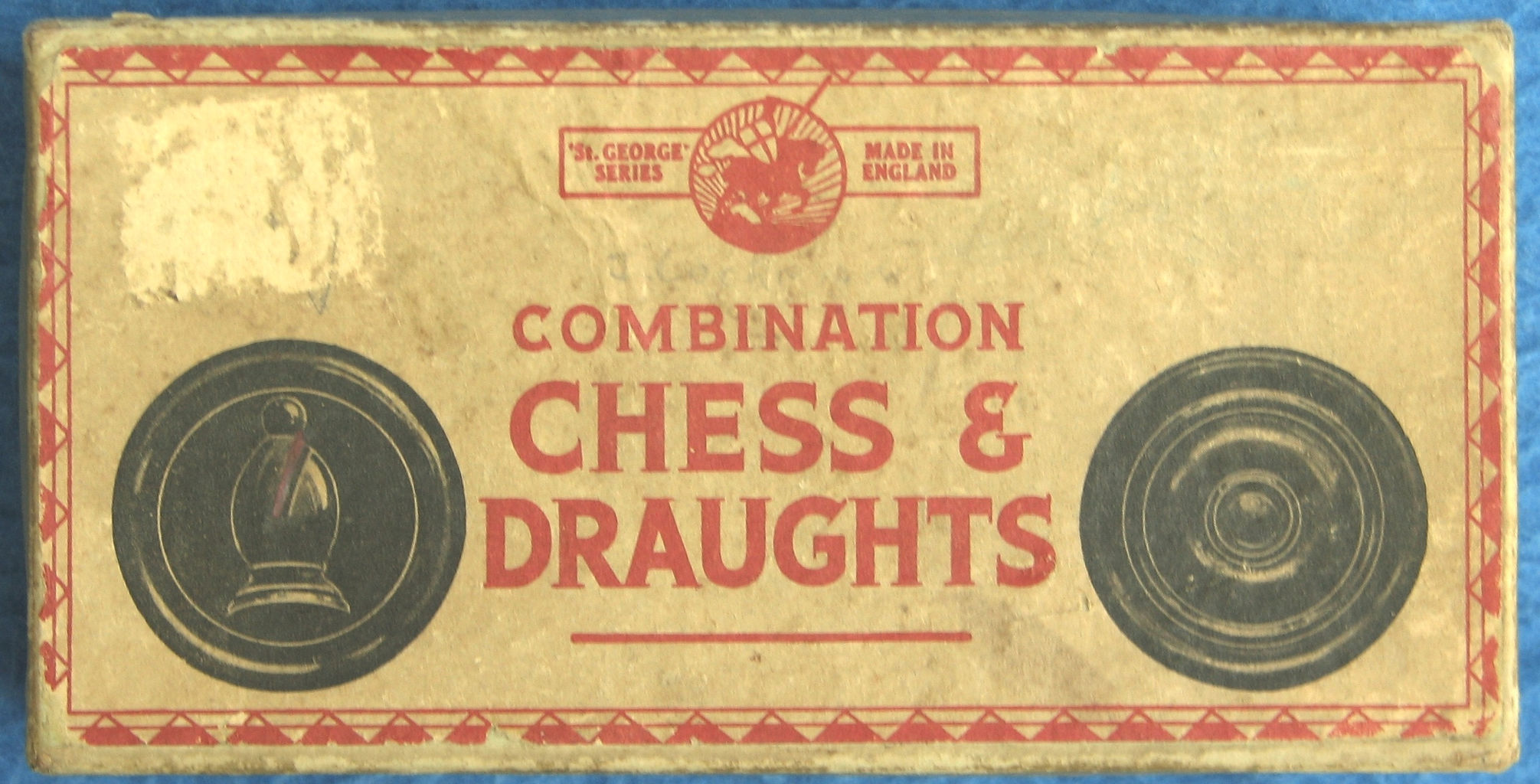
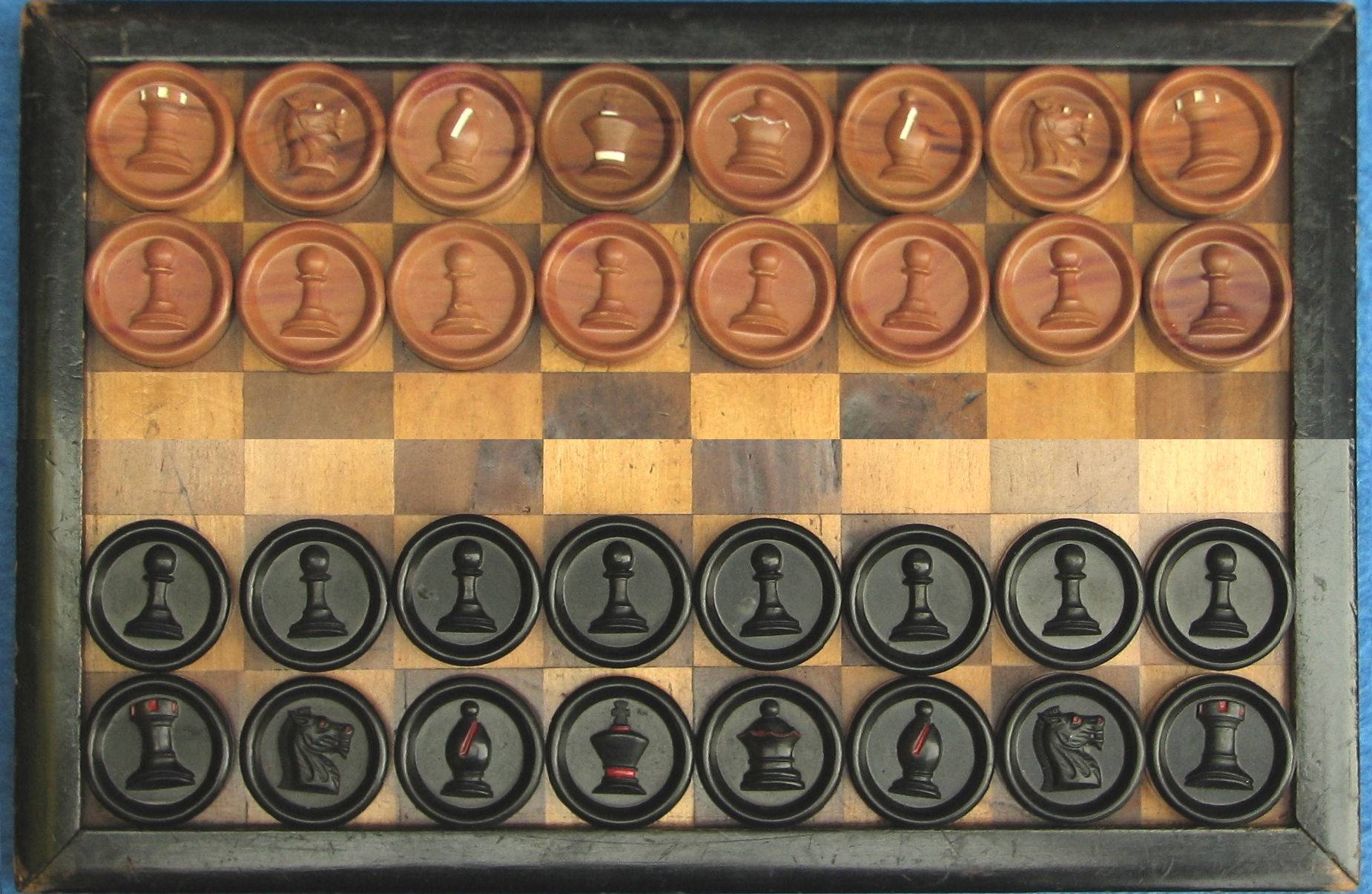
English Bakelite disk pieces (Ø 1⅕” 30mm) by Chad Valley and others ca. 1940
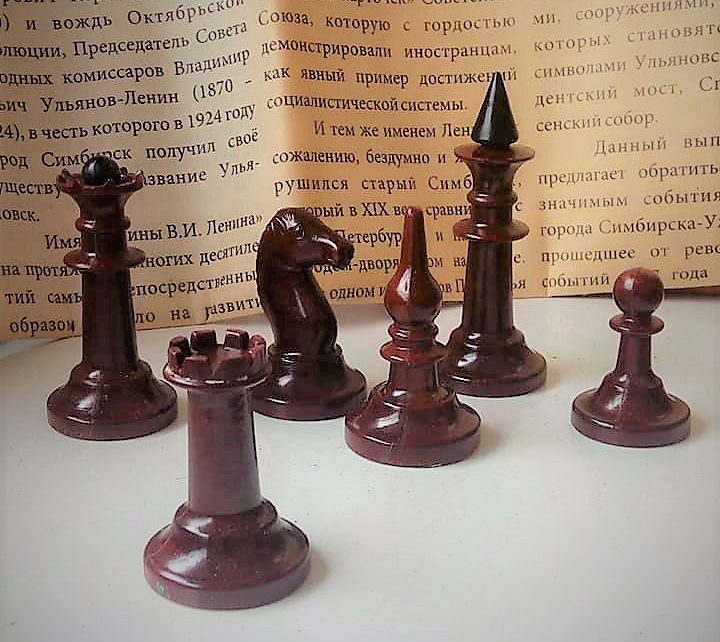
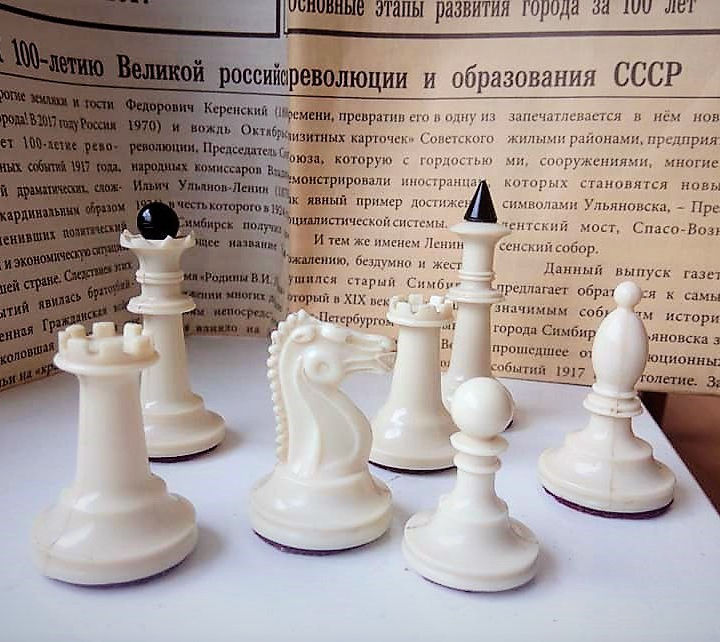
Russian (left) Bakelite 1952 and (right) Carbolite 1962–1980s “Shkolnik” (Scholar) set (images from https://sovietchesssets.com)
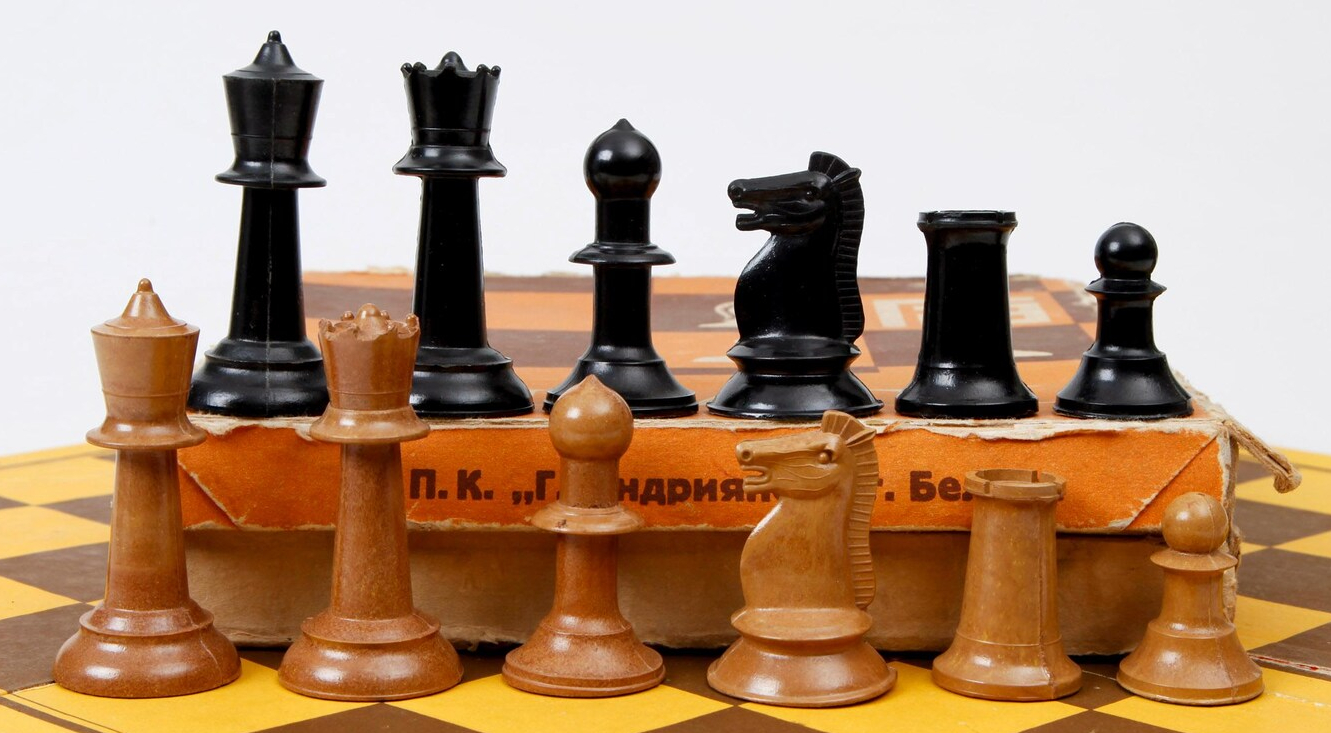
Bulgarian Bakelite Varna Olympiad set (K 3⅖” 87mm) with folding board and box ca. 1970
Carbolite (1914)
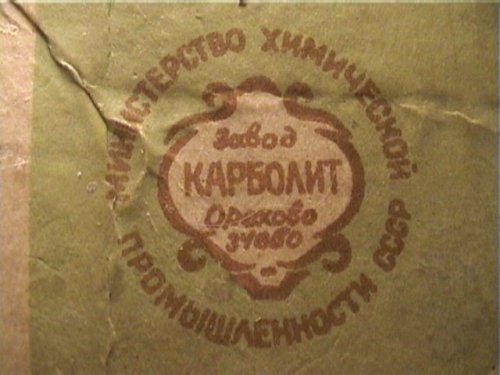
In the USSR, Bakelite was mass-produced under the trade name Carbolite, a phenol-formaldehyde resin variant developed in 1914 by a trio of chemists (Petrov, Lisev, and Tarasov) at the Zuzino silk plant. They founded the Karbolit factory in Orekhovo-Zuyevo, outside Moscow, around 1915–1916 and refined the material further. While Bakelite utilizes a basic catalyst, Carbolite relies on an acidic one, bypassing the need for dark filler materials and allowing for the production of a striking ivory-white plastic alongside the traditional black. Products were made by compression molding.
- The Karbolit factory made the iconic 1940 Soviet Tournament set cast in Carbolite, featuring highly stylized Knights that became a visual staple in Soviet chess culture. Production continued heavily into the 1970s and 1980s for tournament, club, and home use. Actually, prior to the Carbolite white and black set in 1940s, they produced a Bakelite maroon and black version in mid to late 1930s.
- Another, more abstract type set, in different color combinations like red and black or white and black was produced ca. 1940–1950.
- The “Siberian Souvenir Chess Set” was likely produced in the 1980s at the Divnogorsk plant in Siberia. The corpulent chess pieces are cast from Carbolite and rest on gold gilt trimmed brass bases. All stored in a heavy Carbolite box.
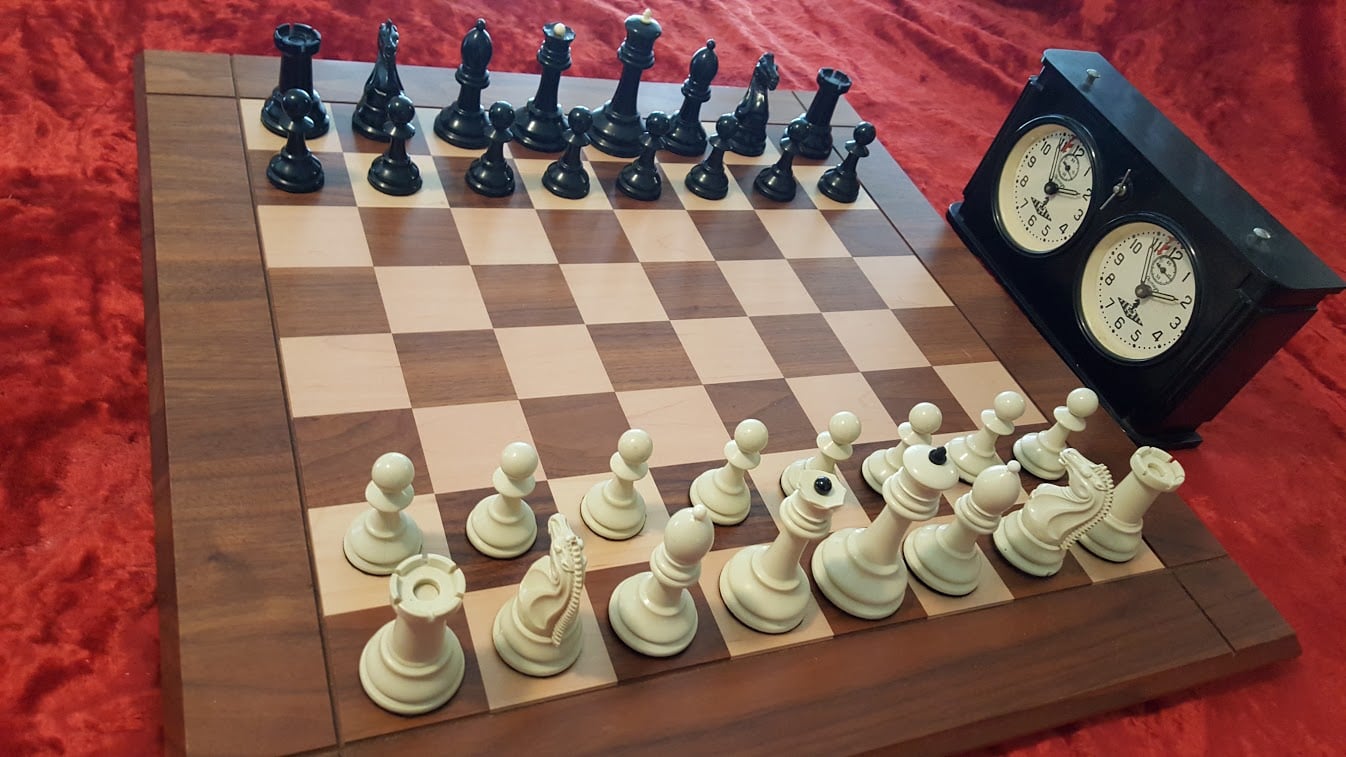
Karbolit factory Carbolite Tournament set (K 4½” 114mm) 1940 (image from https://sovietchesssets.com Ron Harrison collection)

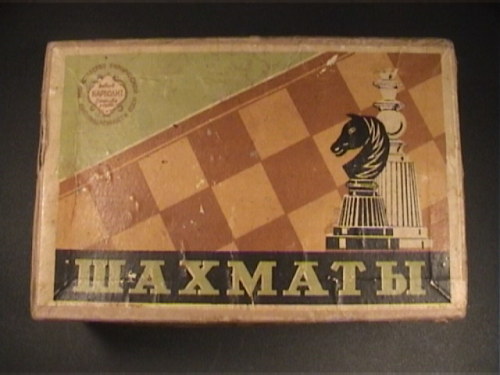
Karbolit factory Carbolite abstract set (K 2⅔” 68mm) ca. 1940–1950
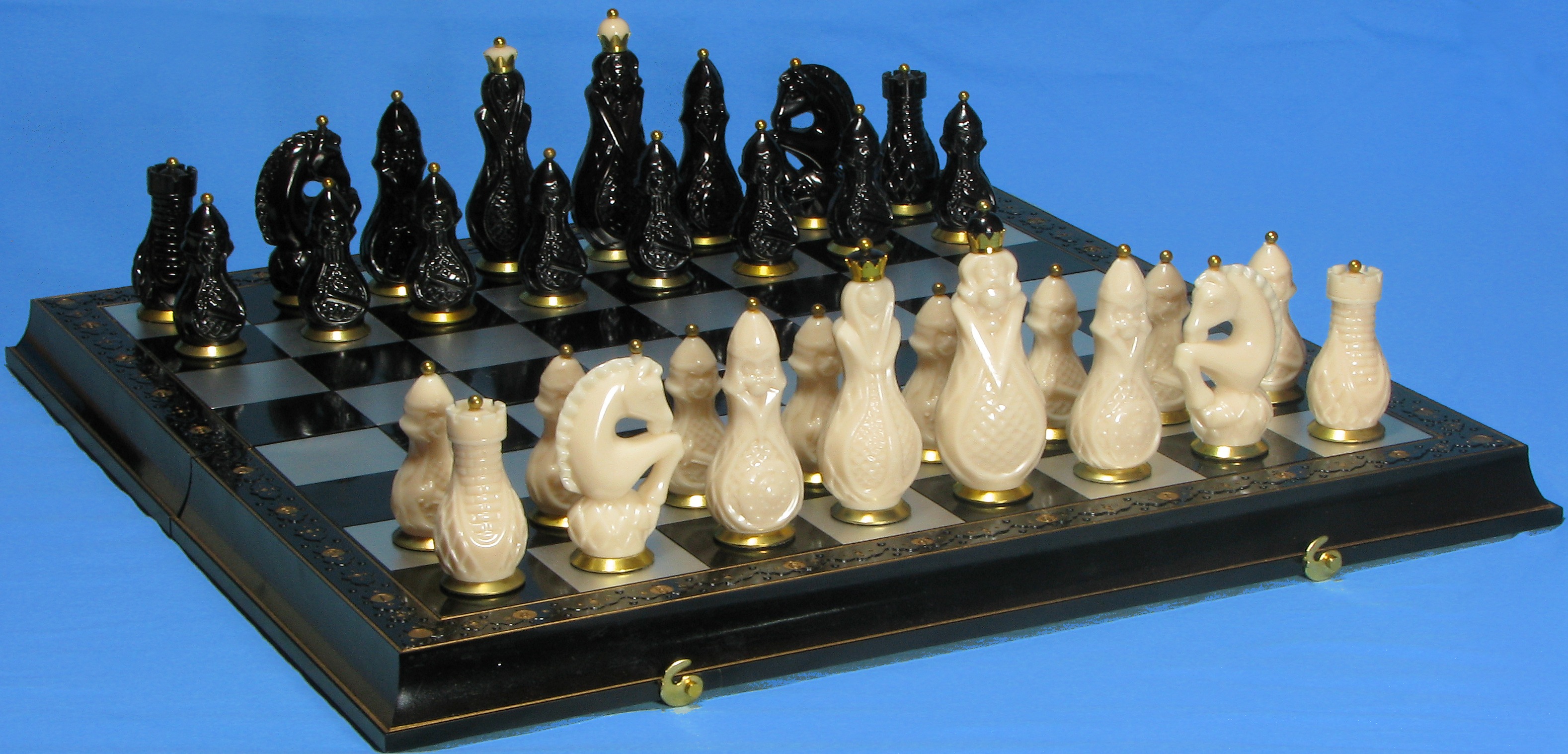
Divnogorsk plant Carbolite+brass “Siberian Souvenir Chess Set” (K 4⅓” 110mm) ca. 1980
Urea (1920s)
Urea-formaldehyde resin or urea resin is related to Bakelite and is the hard, scratch-resistant thermosetting plastic used for mid-range or heavy plastic sets. It was first made in 1884 in a lab by Dr. Hölzer and Bernhard Tollens, though they did not know it was forming a polymer. It was not until 1919 that Hanns John obtained the first official patent for urea-formaldehyde resin in Austria. Other patents, including those for Pollopas (Aminoplast), followed in Vienna until development there ceased around 1924.
It was the massive industrial complex of the Leuna Chemiewerke in Germany that held the production monopoly on the raw material (synthetic urea). Leuna manufactured its own high-quality solid blocks of this Harnstoff-Kunstharz. A bitter patent war ensued between Vienna and IG Farben (owner of Leuna since 1925), which lasted until IG Farben bought all the international patents in 1927.
In the 1930s and 1940s chemical companies like British Beetle and American Plaskon developed urea-formaldehyde into dry industrial pressing powders. This allowed for mass production using high pressure compression-molding. This material was revolutionary compared to Bakelite, because the natural urea resin base is crystal clear, allowing bright white, vivid pastel colors, and beautiful marble effects. Lowe and Gallant Knight in the US marketed sets in urea and Brookes & Adams in the UK made sets in this material itself, but all these sets are extremely hard to distinguish from later polystyrene mass-productions.
- The Leuna mass-produced industrial blocks allowed traditional workshops, like Firma Zänker in Rothenthal, to turn vibrant red and white chessmen on a lathe just like bone or ivory. These rare sets mark a fascinating historical transition, proving that early plastic was not used as a cheap substitute, but celebrated as a premium, highly aesthetic modern material. In this specific set, it is exceptionally hard to distinguish the material from real bone. Many would mistakenly identify it as a bone set from Uhlig.
- A highly unusual travel set (ca. 1925–1930), signed by Ayres, featuring a folding board housed within a leatherette box, has pieces either turned by Ayres itself or imported from Germany. At first glance, the pieces resemble bone, but closer material analysis reveals them to be a very early turned plastic. Galalith came to mind, but the material bears a striking resemblance to the Leuna urea resin blocks. The crazing of the white Knight is in the characteristic cross pattern, while Galalith develops an irregular, cobweb-like network of fine surface cracks.
Frederick Henry Ayres, manufacturer of high-quality sporting equipment (known mainly for outdoor games), chess pieces, and antique rocking horses, started in 1864 in London. The firm became F.H. Ayres Ltd. ca. 1905, before it was acquired during the 1940s by Slazenger, the brand of the golf balls in Goldfinger!
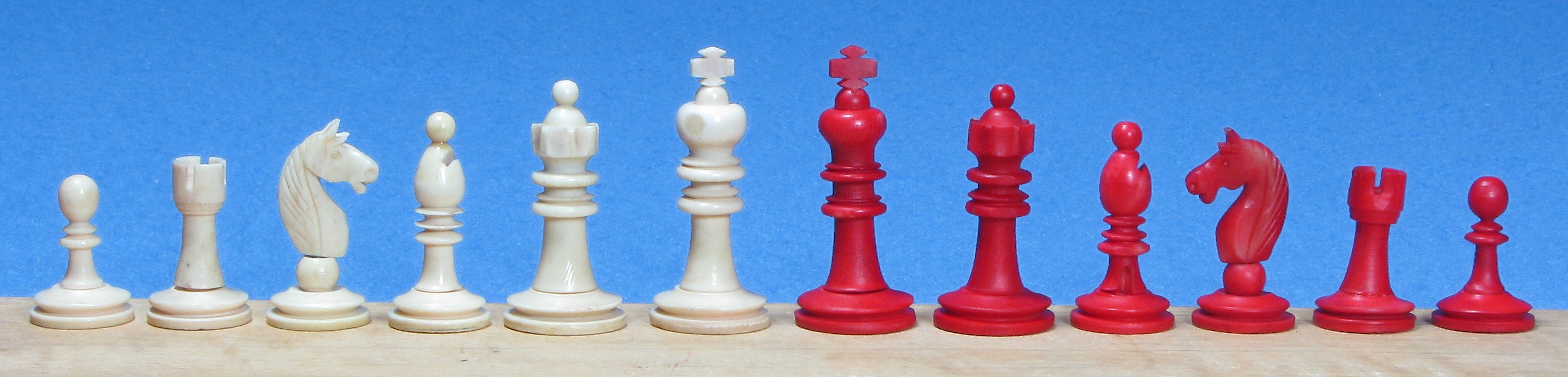
German Leuna Chemiewerke resin Staunton set (K 2⅕” 55mm) by Firma Zänker in Rothenthal ca. 1925
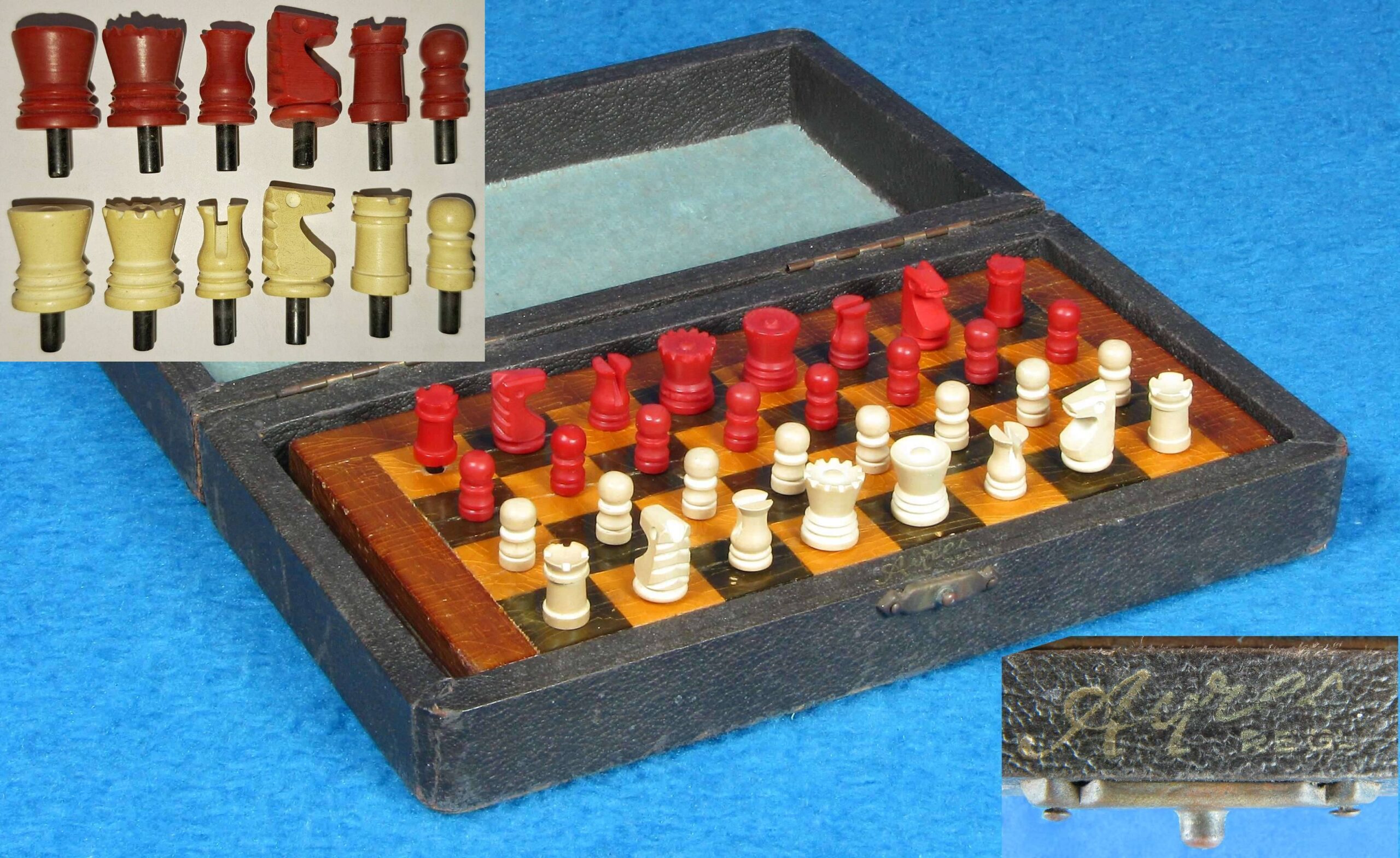
Ayres Leuna Chemiewerke resin travel set (K ½” 13mm) signed “Ayres REGD” ca. 1925–1930
Catalin (1926)
Catalin is a translucent phenolic resin, invented in 1926 by Dr. Fritz Pollak in Vienna, and licensed and trademarked in 1927 by the American Catalin Corporation in New York. It was developed as an improved, filler-free alternative to Bakelite. Because it lacks fillers, it could be produced in brilliant, semi-transparent, and marbled colors. This made it highly popular for consumer products like Art Deco radios, costume jewelry, and desk sets from the early 1930s through the mid-1940s. Catalin was cast in open lead molds and baked at 140–180°F (60–80°C) for several days, after which the pieces required further processing.
- A notable example is the iconic, streamlined Art Deco Grays of Cambridge “Silette Chess” set (1930–1950). Grays of Cambridge is a historic family-run sports equipment brand founded in 1855 by world rackets champion H.J. Gray. Key milestones include expanding into cricket and hockey manufacturing, merging with Nicolls in 1942, and acquiring Gilbert in 2002. The company still exists.
- Some F.H. Ayres sets (ca. 1930) feature pieces that were made by Uhlig in Germany, housed in Ayres’ recognizable leatherette box. German sets were sold in a beech box. See the Urea section for a short history of Ayres.
- The E.S. Lowe Company, Inc. presentation sets (ca. 1946) feature substantial 3¾” 95mm Kings in red and butterscotch or black and butterscotch, packed in luxurious velvet-lined cases. These are often falsely identified as Bakelite. Lowe was a prominent American game manufacturer started by Edwin S. Lowe in the 1920s or 1930s, best known for commercializing Bingo and popularizing Yahtzee. In 1973, the company was purchased by the Milton Bradley Company.
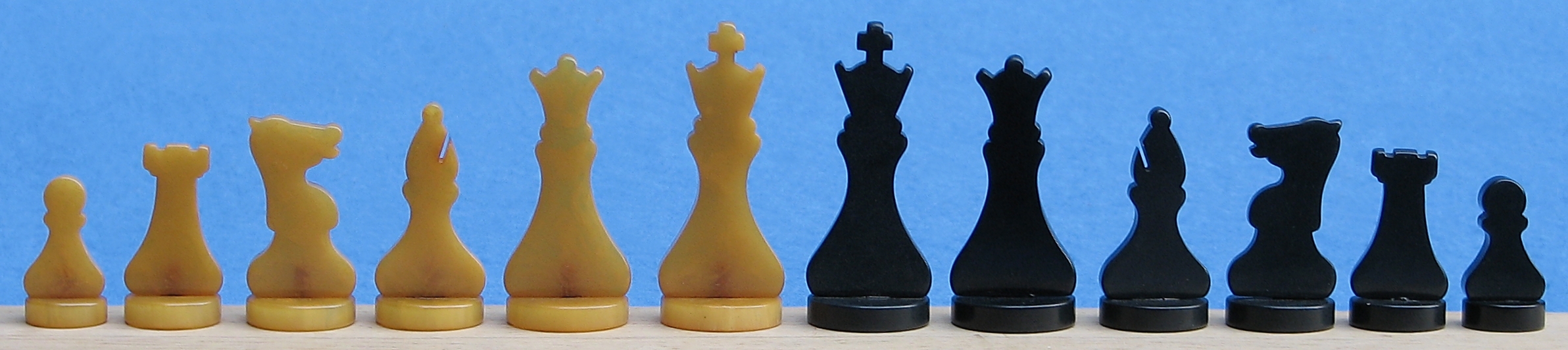
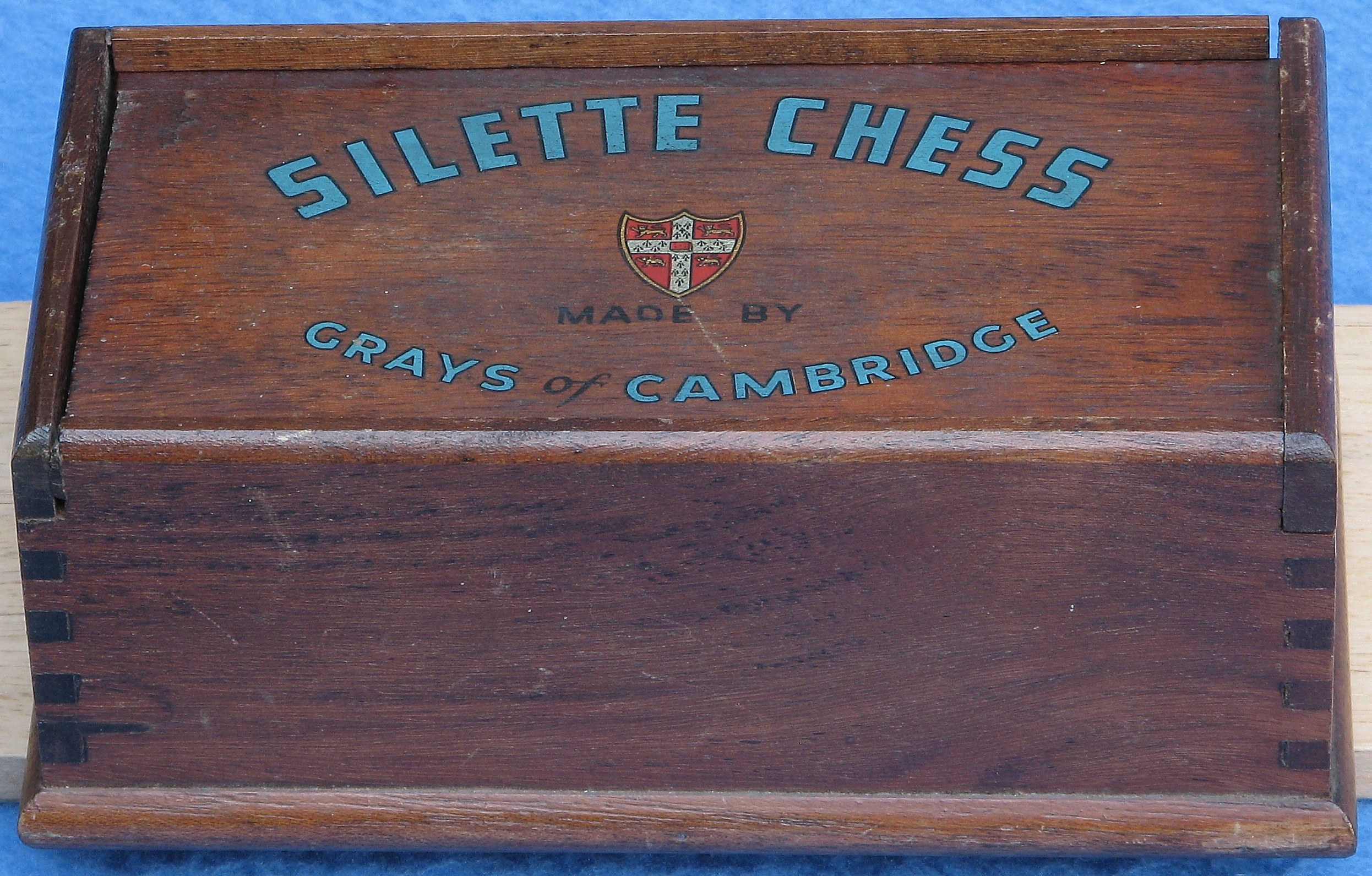
Grays of Cambridge Catalin “Silette Chess” (K 2⅖” 62mm) ca. 1935
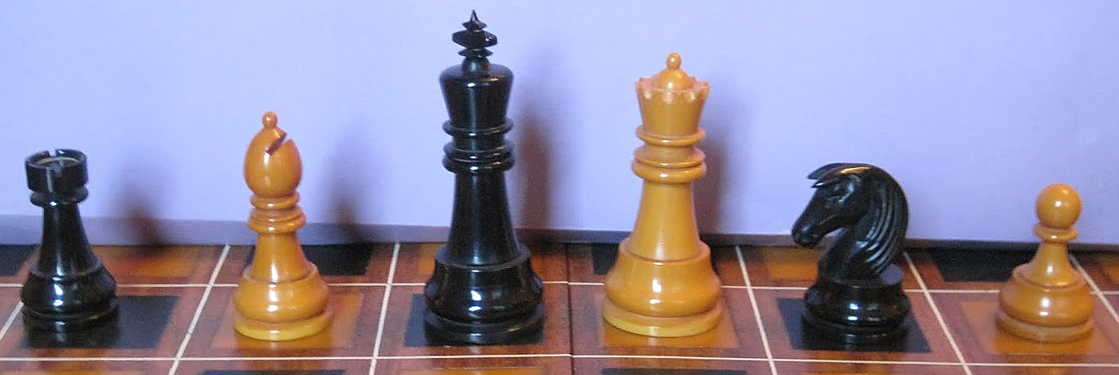
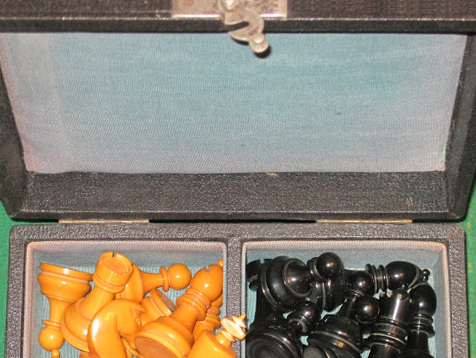
Ayres Catalin Staunton set (K 3″ 76mm) pieces made by Uhlig ca. 1930
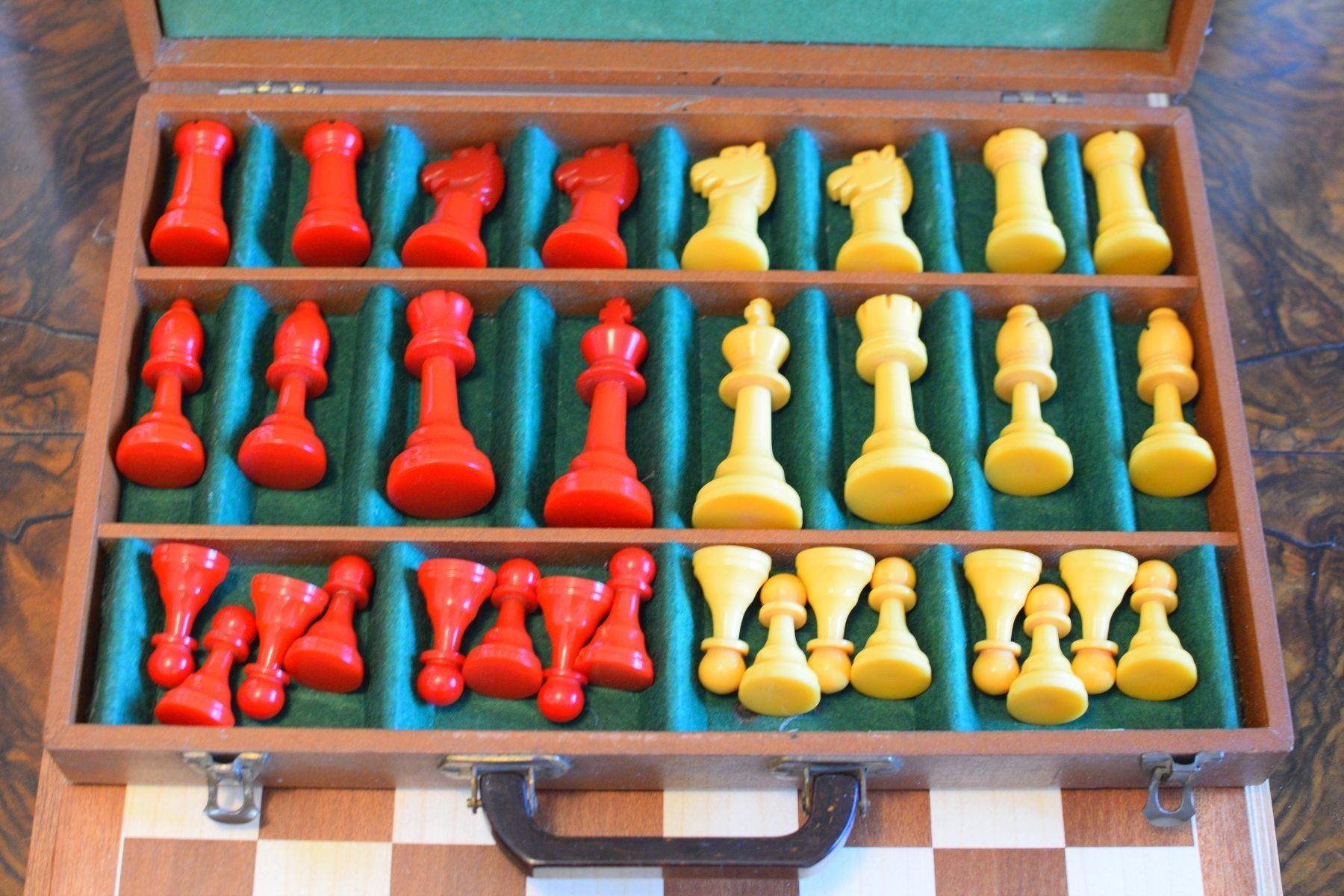
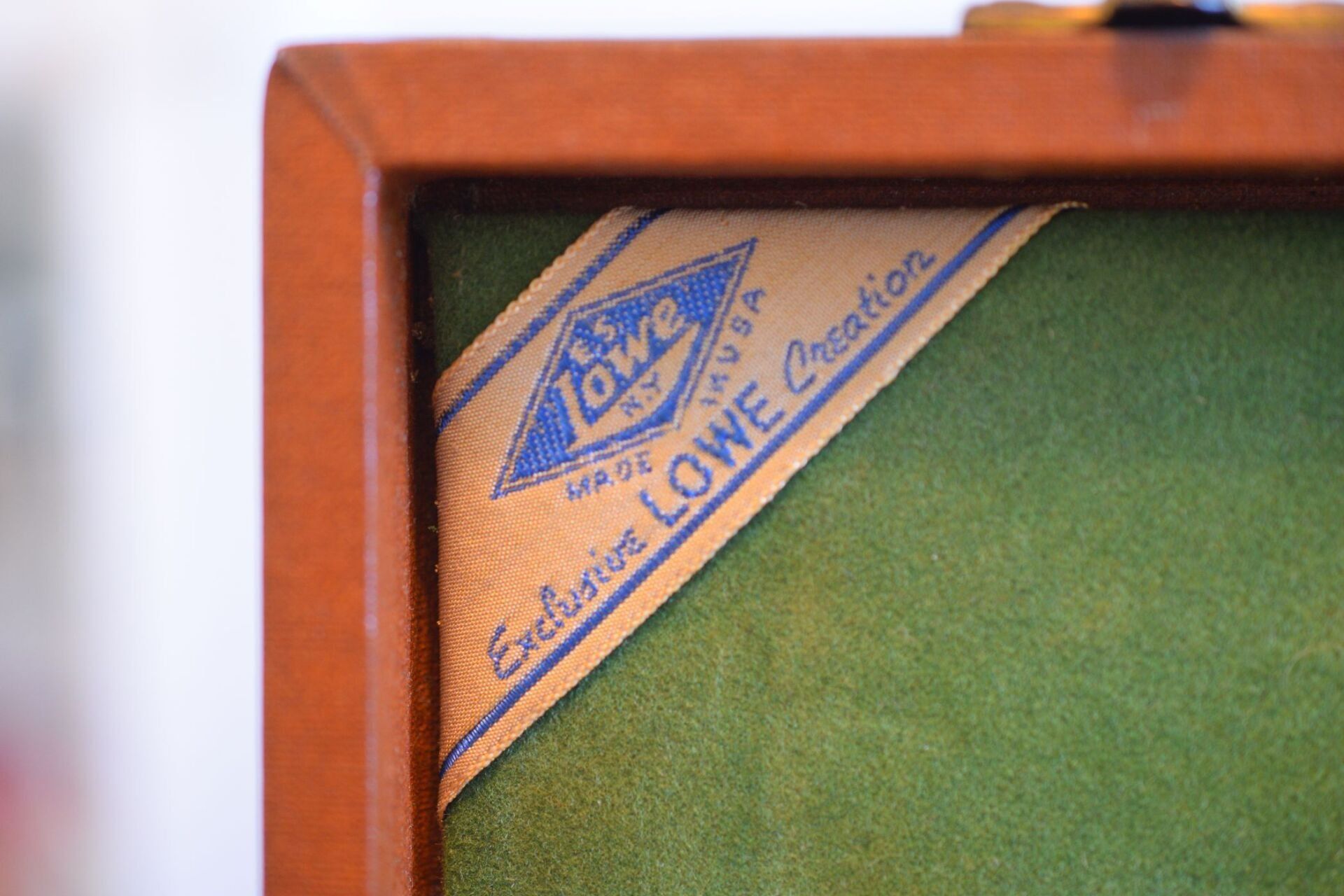
Lowe Catalin Staunton set (K 3¾” 95mm) ca. 1946 (images from https://www.chess-collection.de)
Acrylic (1928)
Acrylic, or acrylic plastic, or plexiglass, named Plexiglas or Lucite (US), Perspex (UK), Altuglas (France), official name PMMA, is a versatile synthetic polymer derived from acrylic acid. It is a petrochemical-based plastic adapted into widely different forms, including solid shatter-resistant sheets, fast-drying paints, and soft textile fibers. Chemists at the German company Röhm & Haas accidentally created the first clear sheet of acrylic plastic in 1928.
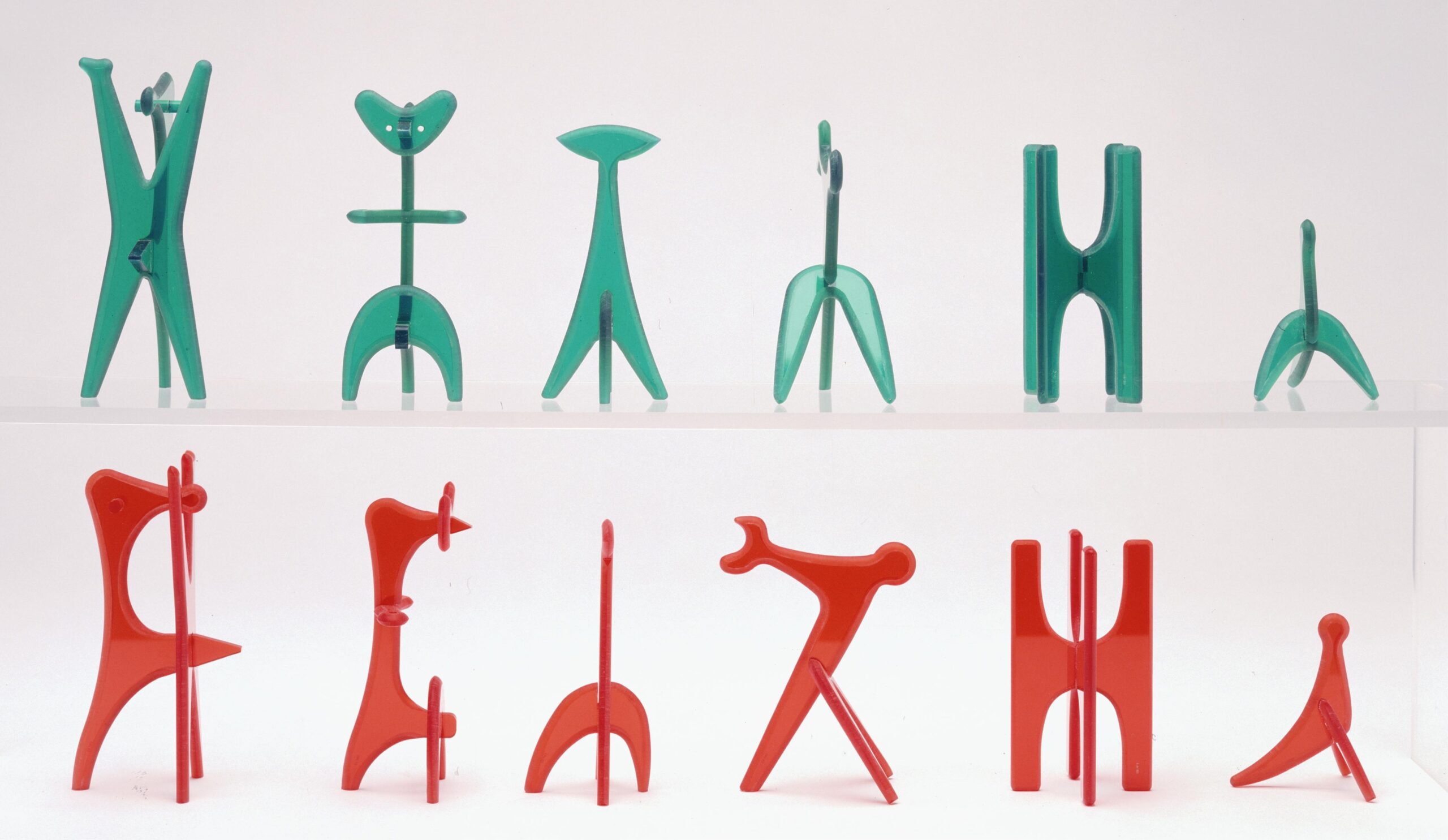
- The Japanese-American sculptor Isamu Noguchi designed an abstract chess set in 1944 using interlocking pieces of red and green plexiglass, which sat on a matching veneer table with plastic insets. Possibly it is the first plexiglass set. The original is lost, but a 2003 replica was exhibited in “The Imagery of Chess Revisited” exhibition in 2005.
- A Staunton chess set, ca. 1940, with box and board all made of acrylic, served as promotion for the dental Oralite Company in Thornton, Blackpool (1906–1967). They looked into acrylic as a possible dental material. An advertising postcard from 1937 states “Oralite: The Premiere Denture material”. So they called the material Oralite.
- The 1960s and 1970s saw an explosion of iconic designer sets, such as the colorful Lucite chess set by Charles Hollis Jones (USA). This design exists in three distinct iterations: the original prismatic version from the 1960s (K 4″ 102mm), a small layered Rainbow version from the 1970s (K 2⅞” 73mm), and the graphic layered Op-Art version on a black-and-white board from the 1970s (K 3″ 76mm).
- Brands like Guzzini in Italy and Michel Dumas in France popularized “clear versus smoked” sets on sleek, translucent board setups in the 1970s. This mass-produced aesthetic remains a highly recognizable classic look today.
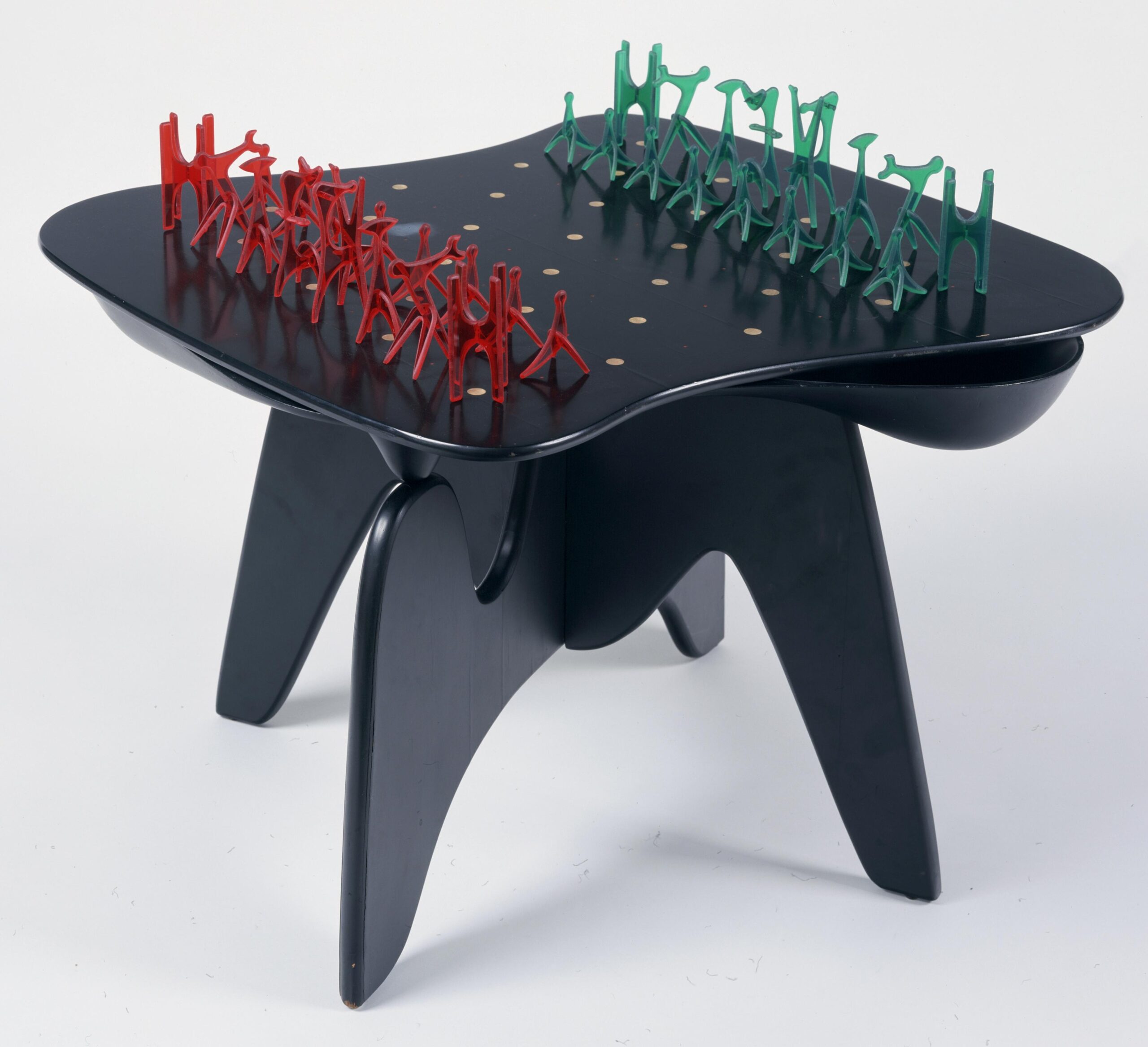
(left) Isamu Noguchi, Chess Table, 1944. Fabricated by Herman Miller. Ebonized plywood, cast aluminum, plastic insets.
(right) Isamu Noguchi, Chess Pieces, 1944. Fabricated by Larry List, 2003. Red and green plexiglass.
Photos: Kevin Noble. © The Isamu Noguchi Foundation and Garden Museum, New York / ARS
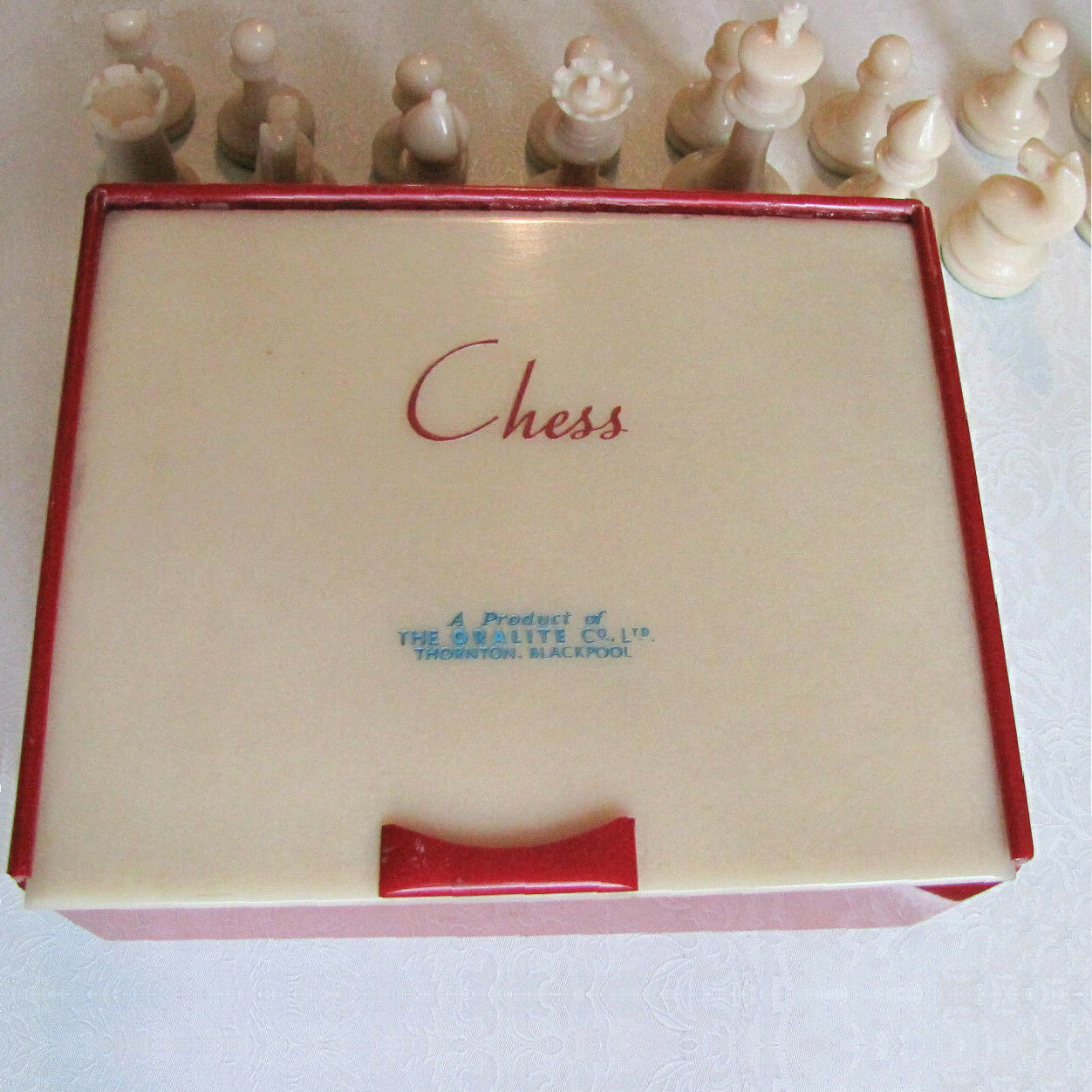
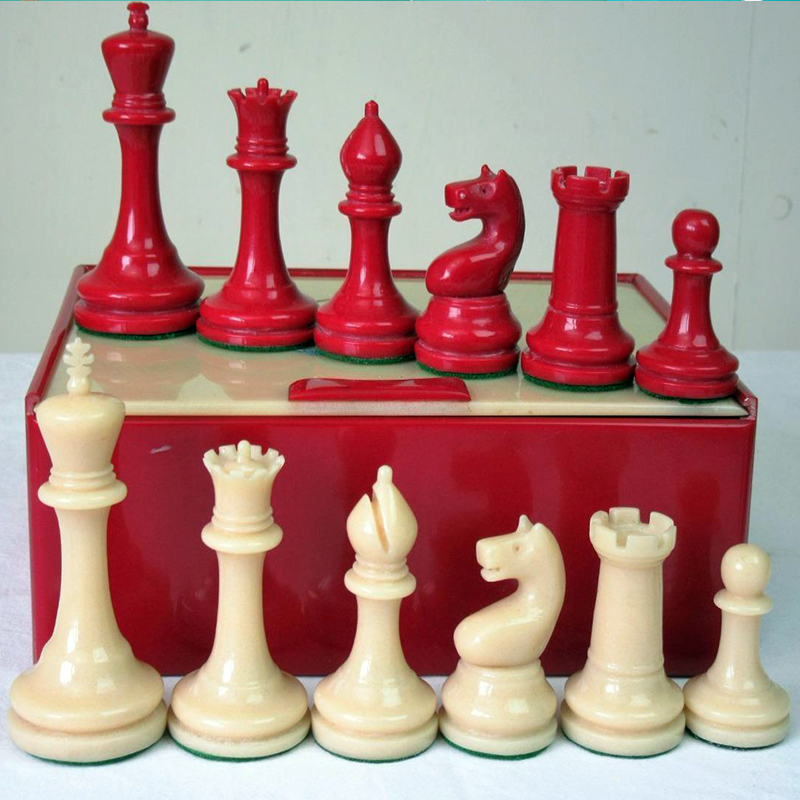
Oralite Co. Ltd. Oralite Staunton set (K 2⁹⁄₁₀” 74mm) ca. 1940
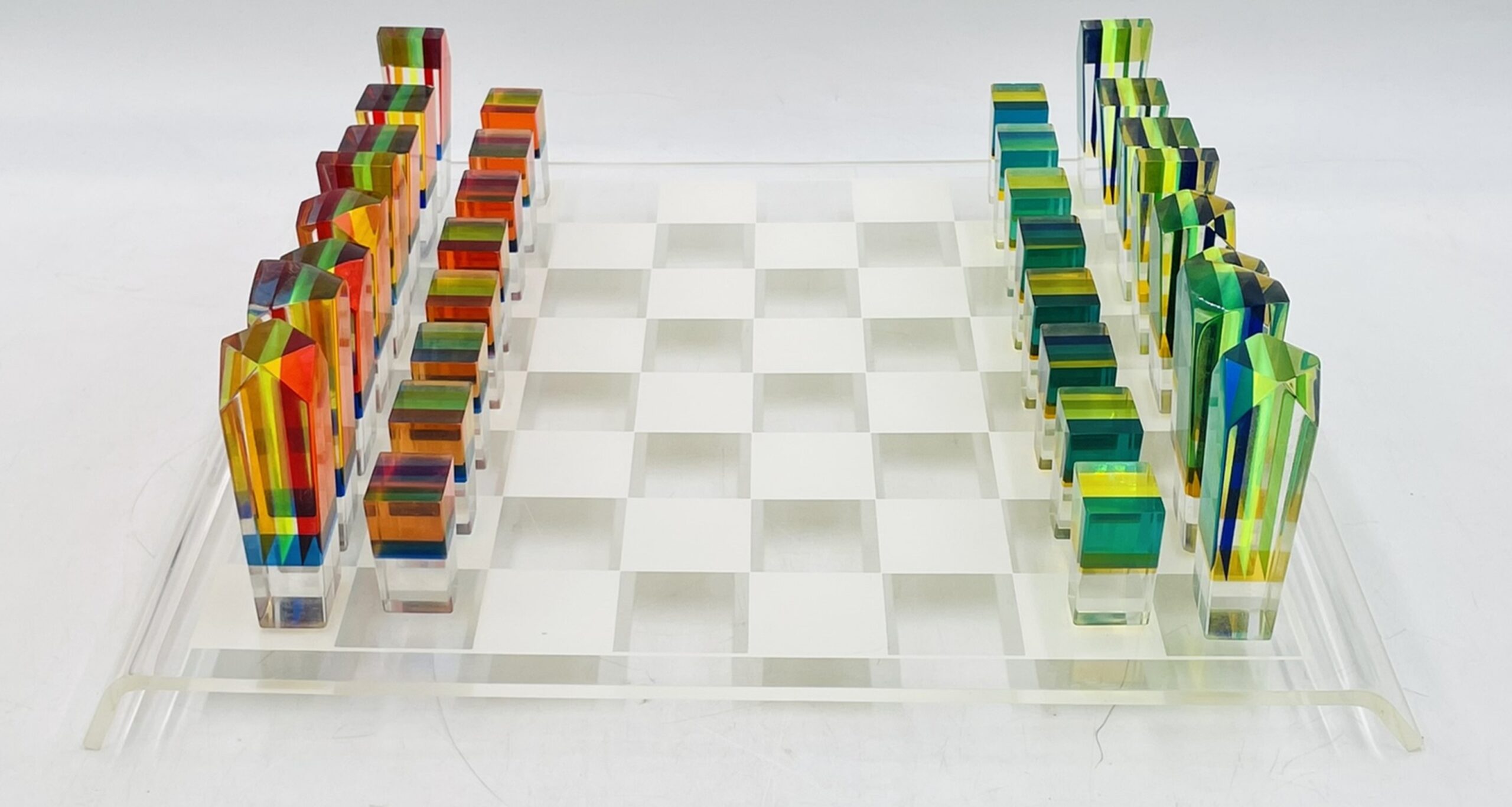
Charles Hollis Jones colorful Lucite Set (K4″ 102mm) ca. 1960
(image for educational review courtesy of Chairish and Cain Modern)
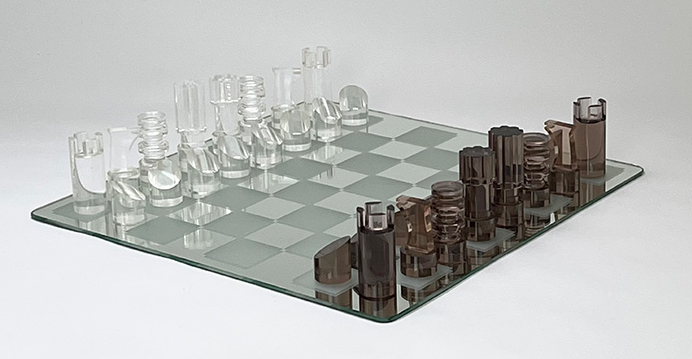
Michel Dumas Altuglas chess set (K 5⅛” 130mm) 1970s (image for educational review courtesy of Galleria62)
Tenite and Polystyrene (1930s)
Tenite, or cellulose acetate, is a wood-pulp-based plastic patented by the Tennessee Eastman Corporation around 1932. Often referred to as “luminous plastic” or “plastic ivory”, it could also feature a marbled effect. Tenite products transitioned from compression molding in the 1930s to injection molding in the 1940s.
Polystyrene is a long-chain synthetic hydrocarbon plastic made from repeating styrene units and is processed by injection molding. It was discovered in 1839 by Eduard Simon, an apothecary from Berlin, though he did not realize he had invented plastic. Polystyrene was later patented in the early 1930s by the Swedish inventor Carl Munters. Interestingly, the first injection molding machine was patented decades earlier, in 1872.
None of the brands listed below made any plastic chess sets themselves, except for Drueke after the purchase of its first injection molding machine in 1954. But Chicago Molded Products Corp., Santay Products Co., and the Dutch Homas were actual producers. Those three transitioned from Tenite to polystyrene by the mid-to-late 1950s.
- Drueke imported French Galalith sets in the 1920s and sourced American Catalin sets in the 1930s, but both are extremely difficult to find. William F. Drueke patent D128794 was issued in 1941 for the iconic 8-sided chessmen. Available in ivory and red or ivory and black, the only size is 2½″ 64mm (actually 2⅓” 59mm), besides a pocket set size of ¾” 19mm, in a pinned and a magnetic version. Set numbers #20, #22, #23(B), and #24 indicate felting and weighting. The sets consist of Tenite until 1954. After that, Drueke produced polystyrene sets by itself, just like its wooden ones.
- The Gallant Knight Company, famed for its knight logo, marketed sets from the early 1940s until its 1959 takeover by ARRCO Playing Card Company, which used the brand until the 1970s. The sets came in different sizes and color combinations, such as white and black or white and red. There are minor variations due to the different molds used. Packaging is either a large cardboard box with individual compartments and a matching board, known as the combination set, or a leatherette box containing a single, half-sized inner tray. Gallant Knight sets started in Tenite. In the late 1940s a lighter Tenite variant was introduced and during the 1950s a switch to polystyrene was made.
- Kingsway Florentine sold its “Replica 11th Century Figures” from 1947 onwards. It was the first affordable, mass-produced chess set featuring figural polystyrene pieces. This bold introduction, just after WWII, by a small American company is historically important, because it pioneered the use of injection-molded polystyrene for chess sets.
- Peter Ganine designed his Gothic set not as a historical replica like the Kingsway Florentine set, but as a modernist, surrealist artist’s design. His 1939 original was ceramic, but in 1947 Bakelite sets, soon followed by polystyrene sets, were distributed by the Pacific Game Company. Officially named the “Sculptured Gothic Chess Set” or alternately “Superba Gothic Chess Set”, it was available in a Salon Edition and a larger Tournament Edition. Peter Ganine designed the Conqueror set in 1962.
- The H. Baron Company of Long Island, New York is best known for its cribbage boards. From the late 1940s until the 1960s, Baron outsourced Staunton sets in various colors, including marbled effects. Most sets are polystyrene, though some compact travel sets and heavier “Economy Club” sets are urea-formaldehyde resin. Baron also marketed Drueke and Gallant Knight sets repackaged in Baron’s own signature green box. The company was ultimately acquired by Crisloid in 1972.
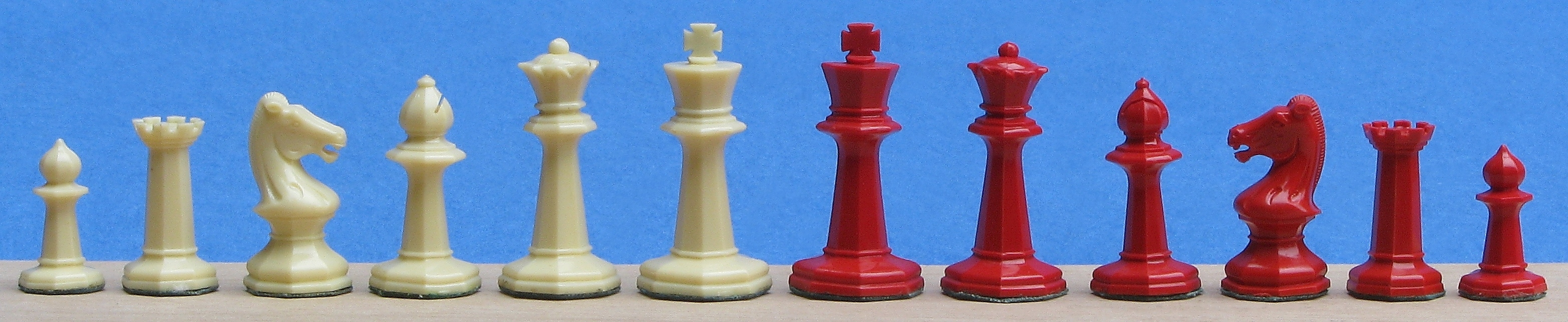
Drueke Tenite Staunton set (K 2⅓” 59mm) sold by Baron 1940s
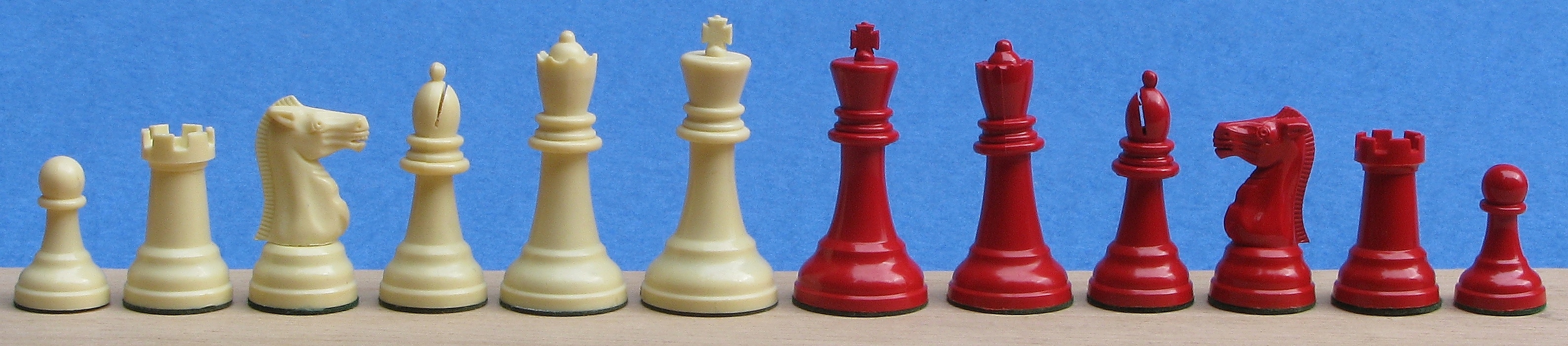
Gallant Knight Tenite Staunton set (K 2¾” 70mm) sold by Baron 1940s
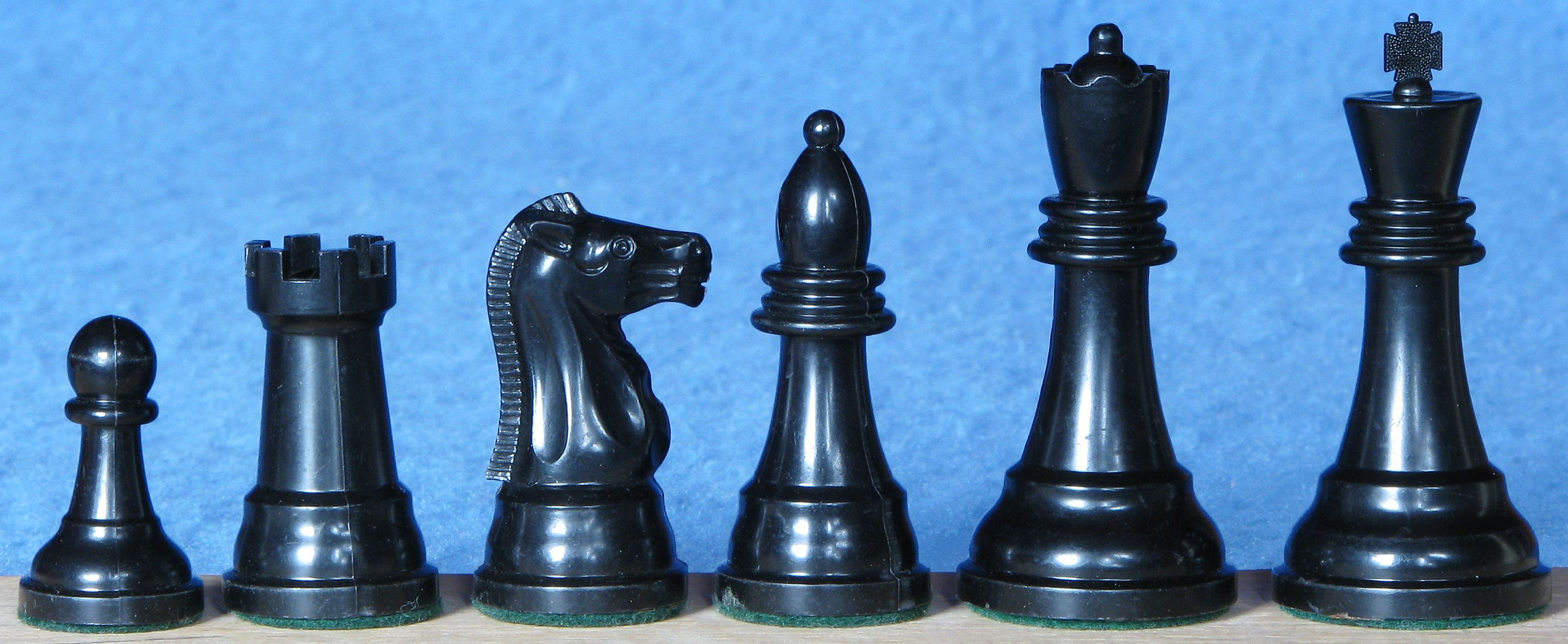
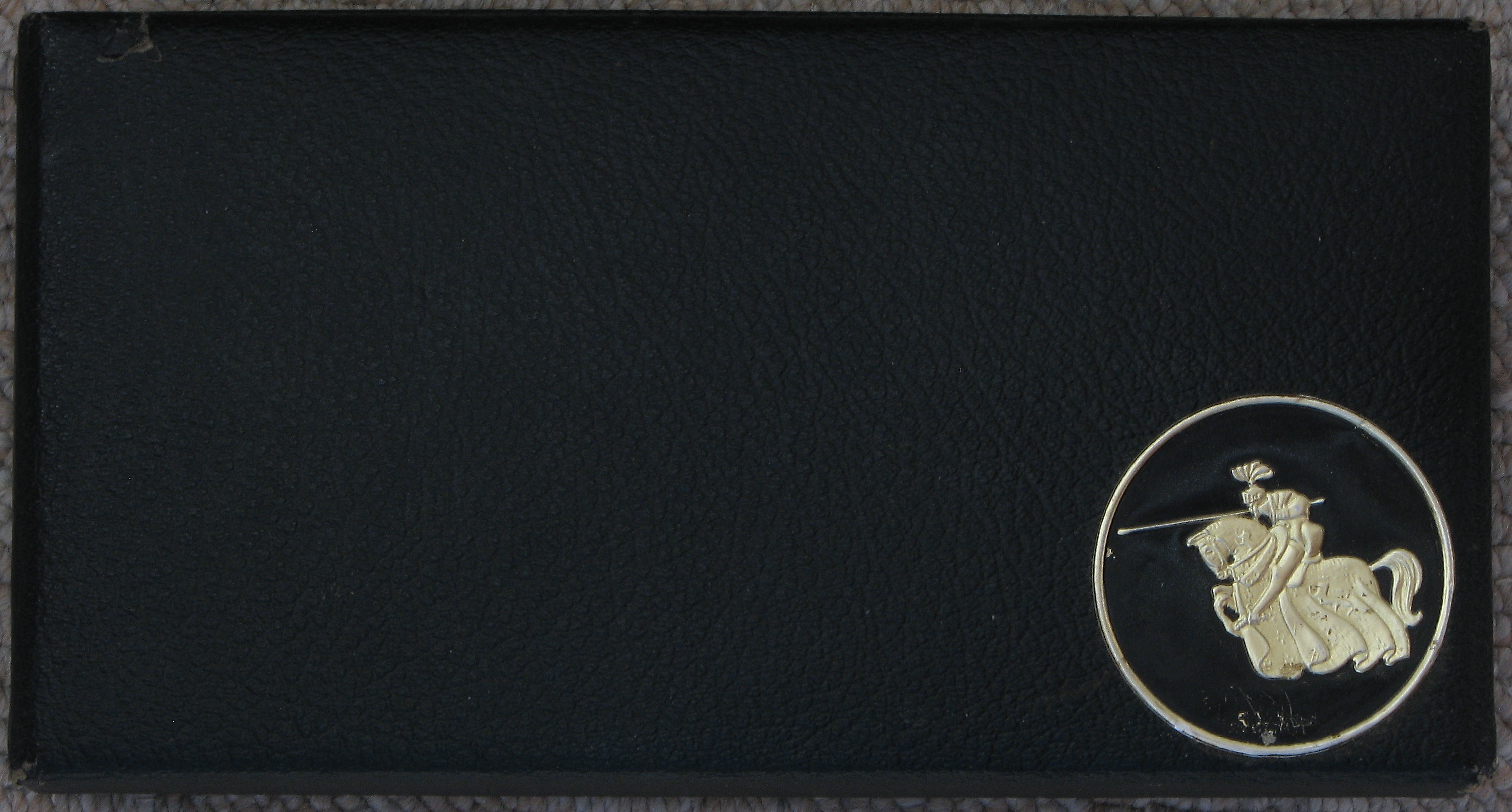
Gallant Knight polystyrene Staunton set (K 2¾” 70mm) 1950s
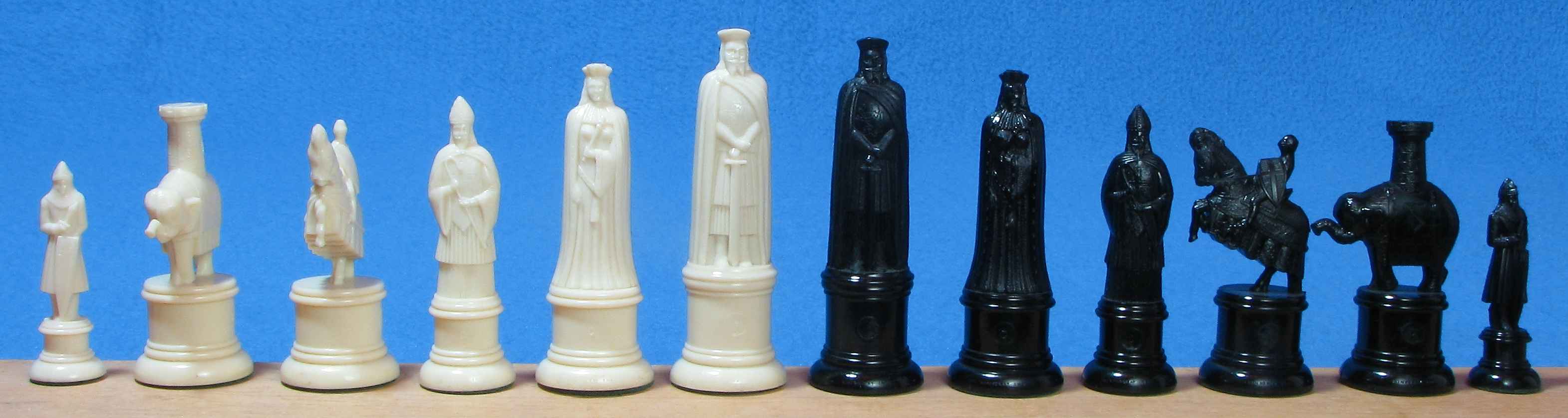
Kingsway Florentine polystyrene “Replica 11th Century Figures” set (K 4⅒” 104mm) 1947
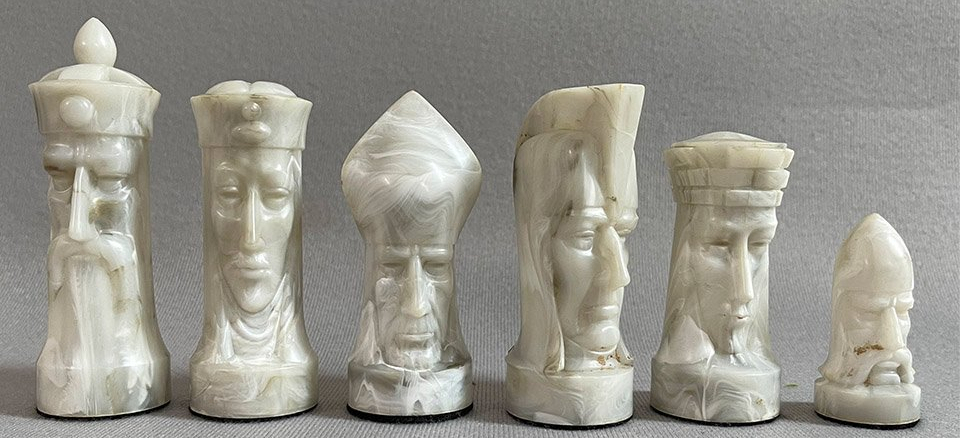
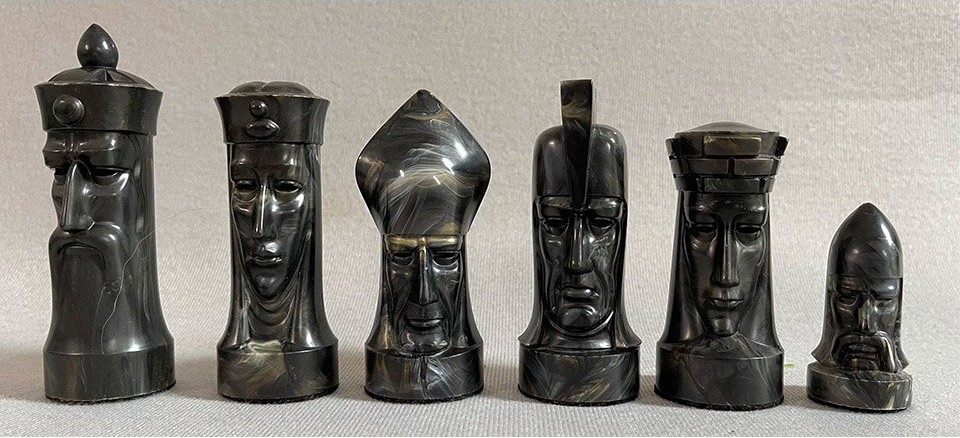
Peter Ganine polystyrene Gothic set Tournament Edition 1957 (images for educational review courtesy of chessantiques.com)
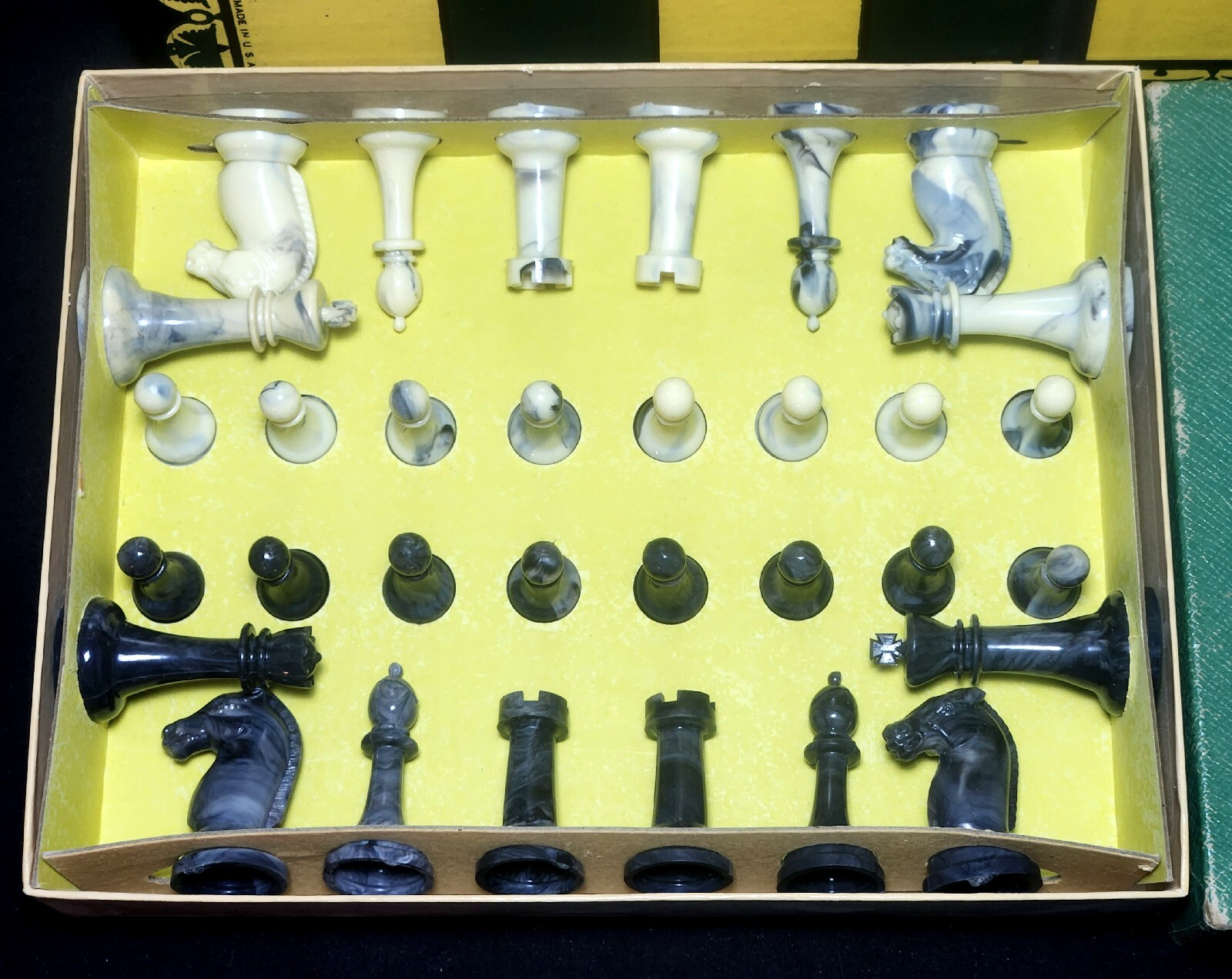
Baron polystyrene Staunton set (K 3⅓” 85mm) 1955–1962
Fenolit (1936)
Fenolit is an early, high-density phenolic resin manufactured by the Argentinian Bakelite company Malaspina, Ferrari & Cia.
By courtesy of Nahuel Crusta the following can be shared.
In 1936, Roberto Gabriel Grau, cofounder of the Argentine Chess Federation (FADA) and the FIDE, convinced the latter to bring the 1939 Olympiad to Buenos Aires and was appointed as the organizer. He contacted Malaspina to create a dedicated tournament set, resulting in the legendary “Magistral” set. It was designed in 1936-1937, and after that produced till February 1939 when all 260 tournament sets were finished.
The manufacturing process explains why these early Fenolite pieces vary significantly in size and weight. The individual molded parts were created using spin-cast compression molding, assembled entirely by hand around an internal metal screw, with their bases manually filled with lead and separately mounted. Notably, the black pieces were painted for an ebony look, causing them to fuse together, whereas the white pieces can still be unscrewed. Contrary to persistent collector myths, the official tournament sets were never gifted to participants, nor were the tournament and later commercial sets produced in two different sizes.
From the end of the Olympiad until 1948, Malaspina used the original molds for commercial sets, including sets of other compositions, such as resins with vegetable aggregates, quartz powder, and other early plastics. While the elite tournament sets came in the iconic tower box with a secure screw-on bottom, the commercial sets used a click-system. The final 1948 commercial run was a “commemorative” set featuring red pieces in a red cardboard box.
An ultra-rare leaflet from ca. 1940 promotes these sets. It is illustrated by pictures of Menchik, Piazzini, Capablanca, and Alekhine playing in the Olympiad. Note that Piazzini is misspelled as Piazzimi and Alekhine labeled as ex world champion, while he had regained it from Euwe in 1937.
From 1949 through the 1970s, a second generation of the Magistral set was produced using entirely new molds.
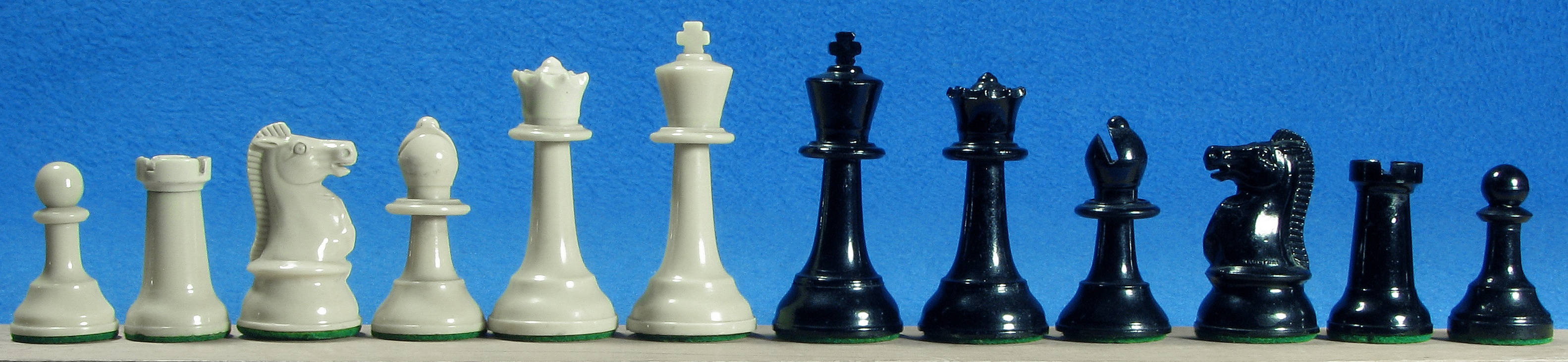
Malaspina Fenolit Staunton “Magistral” set (K white 3¾” 95mm and black 3⅝” 92mm) 1939
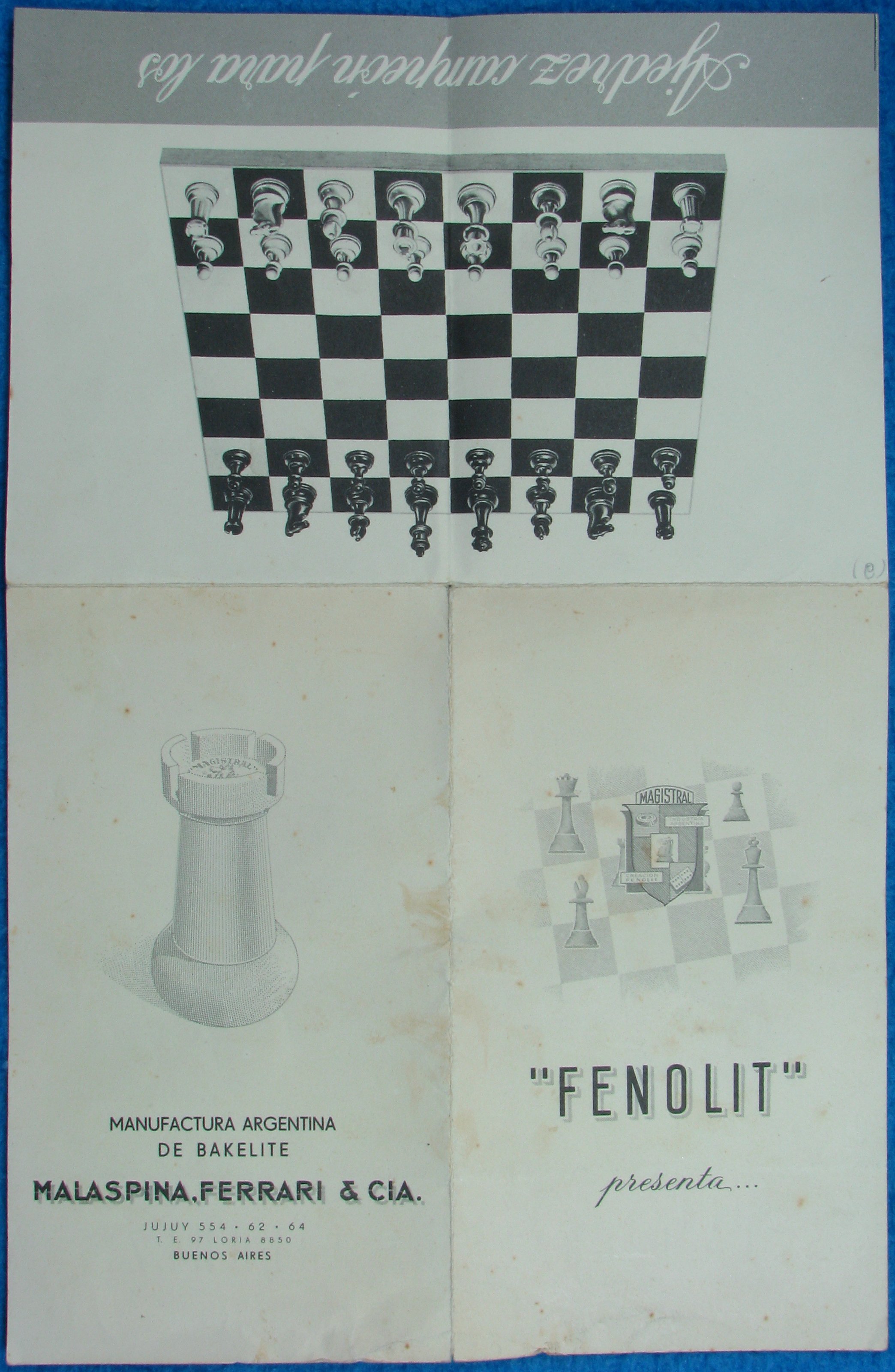
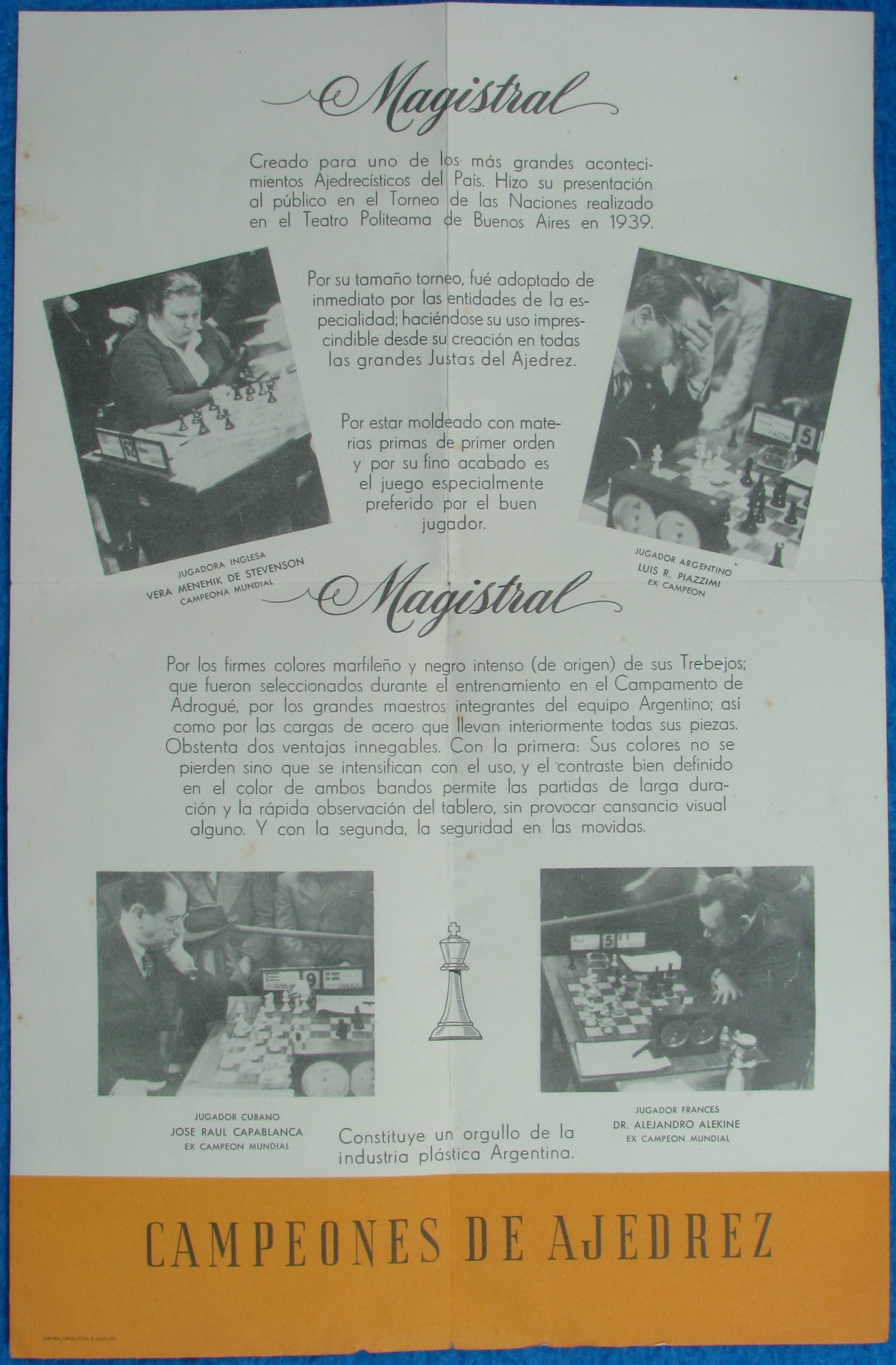
Advertising leaflet of Malaspina Fenolit Staunton “Magistral” set ca. 1940